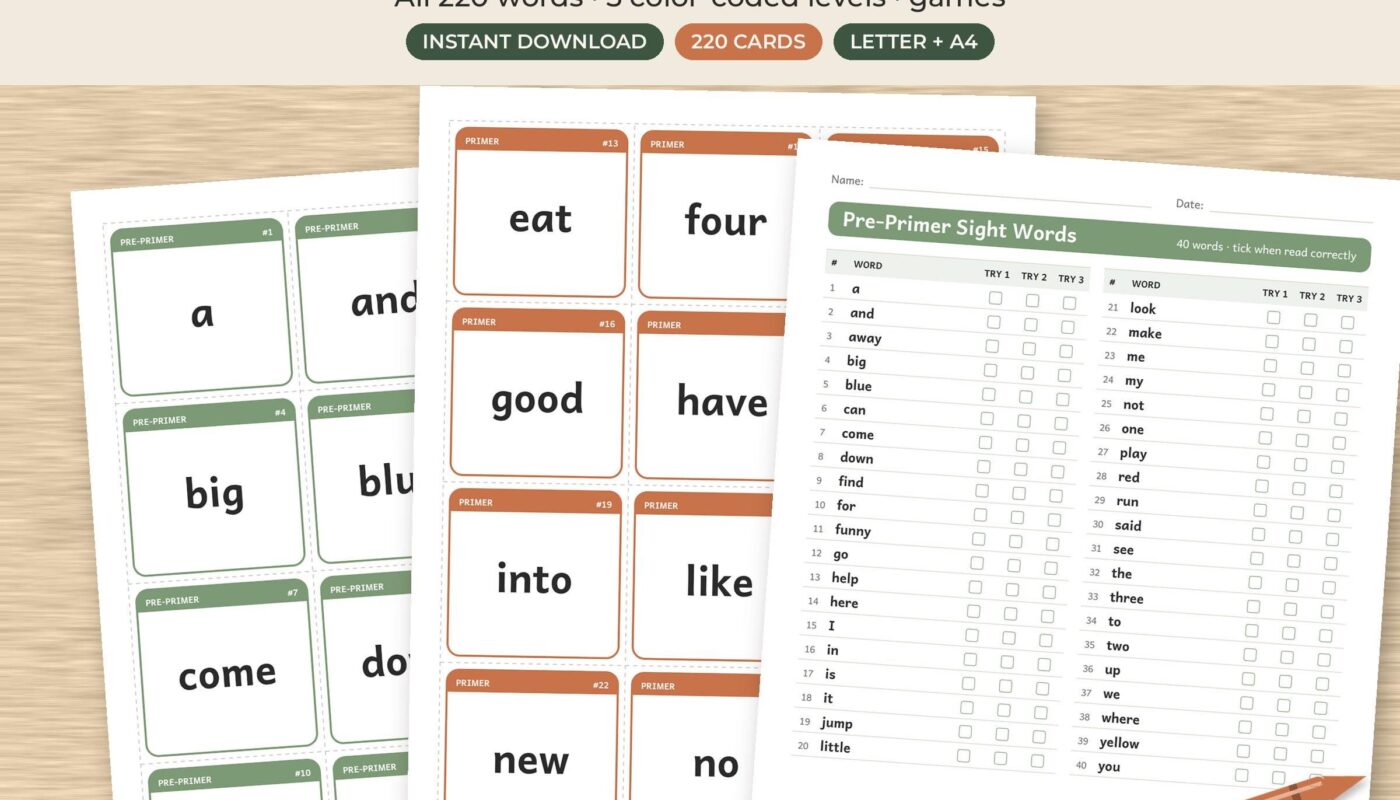
The best way to teach sight words at home is short and daily: pick 3 to 5 words, sound out every part you can, point out the one tricky bit, then read and write each word several times over the week. Ten minutes a day beats an hour on Saturday. And it works far better than drilling a long list of flashcards by shape alone.
This guide shows you how to teach sight words at home step by step, how the Dolch sight words list by grade is organized, how many words a kindergartner usually works on, and what to change if your child is a struggling reader.
Sight words vs high-frequency words: what’s the difference?
People use these terms as if they mean the same thing. They don’t quite.
- High-frequency words are the words that show up most often in print: the, and, was, said, you.
- Sight words are any words a reader knows instantly, without sounding them out. For a fluent adult, almost every word is a sight word.
Reading Rockets explains that the most common 100 or so words make up about half of the text we read, and about a quarter of the most common words have irregular spellings. That’s why early readers get so much value from learning them well.
The goal, then, isn’t to memorize a picture of each word. It’s to turn high-frequency words into true sight words, stored in memory and read in a flash.
Are sight words still taught with phonics?
Yes, and that’s the key change from how many of us learned. Today most schools teach sight words through phonics, not instead of it.
Here’s why. Most “sight words” are actually decodable, or nearly so. Can, and, big, it, not follow regular letter-sound rules. Even the odd ones are only odd in one spot. In said, the s and d behave normally; only the ai is unexpected.
Reading Rockets calls the process of locking a word into memory orthographic mapping: linking the letters, the sounds and the meaning. It also warns that memorizing word lists without phonics and phonemic awareness won’t build a sight word vocabulary. The U.S. Department of Education’s practice guide on foundational reading skills for K-3 rates teaching children to decode, write and recognize words as backed by strong evidence.
In the UK, these irregular words are called tricky words in many phonics schemes. The national curriculum for England calls them “common exception words” and expects Year 1 pupils to read them while “noting unusual correspondences between spelling and sound.” Same idea, different label.
What is the Dolch sight word list?
The Dolch list is a set of common words compiled by educator Edward Dolch in the 1930s. It’s still the list many U.S. kindergarten and first-grade teachers send home. It has 220 “service words” split into five levels, plus 95 common nouns.
| Dolch level | Typical grade | Number of words | Sample words |
|---|---|---|---|
| Pre-primer | Pre-K to early K | 40 | a, and, big, can, come, down |
| Primer | Kindergarten | 52 | all, am, are, be, but, came |
| First grade | Grade 1 | 41 | after, again, could, every, from |
| Second grade | Grade 2 | 46 | always, because, been, before, does |
| Third grade | Grade 3 | 41 | about, better, bring, carry, done |
| Nouns | Across K-3 | 95 | apple, baby, bed, chair, day |
Word counts come from the Dolch word list published by ReadWriteThink. The grade labels are a rough guide. Your child’s school may use the Fry list or its own list instead, so check the teacher’s handout before you start.
How many sight words should a kindergartner know?
There’s no single national number. Expectations depend on your state, your school and the reading program it uses.
As a practical yardstick, many kindergarten classes work through the pre-primer list (40 words) and start on the primer list (52 words) by the end of the year. Other schools set their own targets, higher or lower. If your child knows 20 solid words in February and is still adding more, that’s progress, not failure.
The better question is how they know them. A child who reads was instantly in a sentence is ahead of one who can name 100 flashcards but stalls on real books.
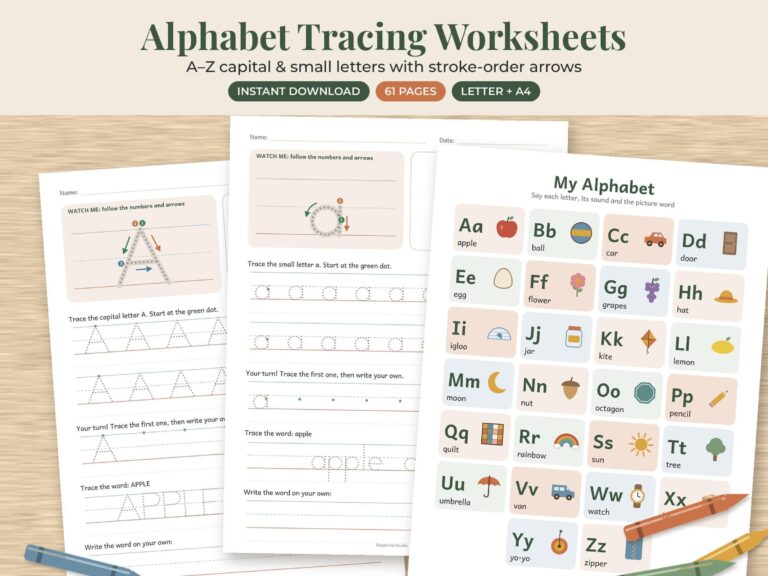
For 4 to 5 year olds who aren’t in kindergarten yet, we’d hold off on sight word lists until your child knows most letter sounds. Letters first, words second. Tracing pages like these A to Z alphabet tracing worksheets are a gentler place to begin.
How to teach sight words at home: a 6-step routine
This is the routine we’d use with a kindergartner. It takes about 10 minutes and fits before dinner or after school.
- Say the word and use it in a sentence. “The word is said. Mom said it’s time to eat.”
- Tap the sounds. Have your child say each sound while tapping a finger: /s/ /e/ /d/. Three sounds.
- Match sounds to letters. Write the word. Point to each letter or letter group as you say its sound. S says /s/. D says /d/.
- Mark the tricky part. Underline or circle the part that doesn’t follow the usual rule. “In this word, ai says /e/. That’s the part we have to remember by heart.”
- Write it from memory. Cover the word and ask your child to write it. Writing makes them notice every letter.
- Read it in a sentence. Use a short sentence or a simple book. “I said hi.” This is where the word becomes useful.
Then add the word to your review pile and go over the whole pile quickly every day.
How many sight words a day should I teach?
Introduce 3 to 5 new words a week, not a day. Reading Rockets suggests teaching a small number at a time, introducing them on their own first, and doing daily review of words already taught. Skilled readers may need only one to four exposures to store an irregular word. Beginners usually need a lot more practice than that, spread over days.
A simple rule: don’t add new words until your child reads last week’s words quickly and correctly on two days in a row.
A sample week of sight word practice
Here’s how a week might look with three new words: said, was, come.
| Day | New words | Activity (about 10 minutes) |
|---|---|---|
| Monday | said, was, come | Run the 6-step routine for each word. |
| Tuesday | Review | Flashcard flip with the review pile, then write each new word from memory. |
| Wednesday | Review | Word hunt: find the three words in a picture book or a cereal box. |
| Thursday | Review | Build each word with magnetic letters, then mix the letters and rebuild. |
| Friday | Check | Read a few short sentences that use all the words. Fast and correct? Add new words next week. |
If you want to see progress, a sticker on a simple chart works. It’s the same idea as a printable chore chart: small wins, marked every day.
Sight word games that don’t need screens
Games keep the daily review from feeling like a test. A few that work well:
- Flashlight hunt. Tape 5 word cards around a dark room. Your child finds and reads each one with a flashlight.
- Swat it. Lay 6 cards on the table. You say a word, they swat it with a fly swatter or a rolled-up paper.
- Memory match. Two copies of each card, face down. Read the word aloud every time you flip one.
- Beat the timer. How many cards can they read in 30 seconds? Next day, try to beat it.
- Rainbow writing. Trace one word three times with different colored pencils, saying the letters each time.
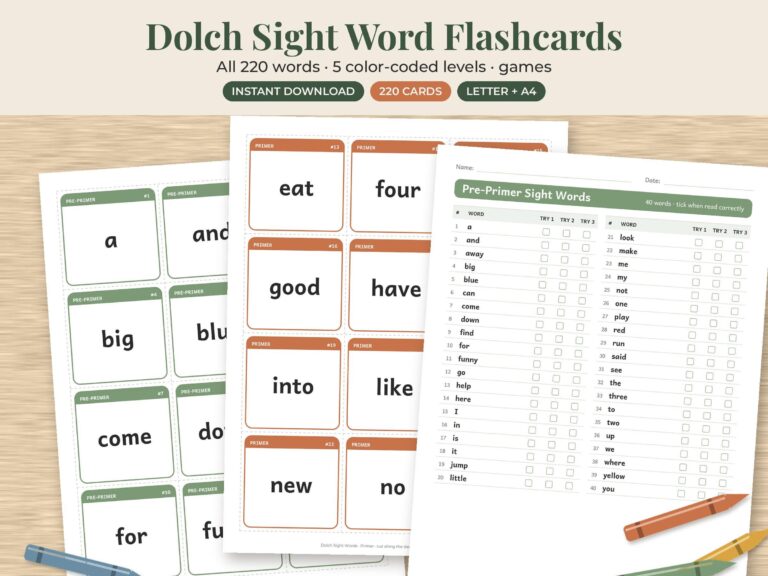
Printed Dolch sight words flashcards save you from hand-writing hundreds of cards, and a set sorted by level makes it easy to see which list your child is on.
How to teach sight words to struggling readers
If your child is stuck, more drilling usually isn’t the answer. Look underneath the words first.
Check the foundations
- Can they say the sound for each letter quickly?
- Can they hear the separate sounds in a short word like map? (/m/ /a/ /p/)
- Can they blend sounds into a word when you say them slowly?
If any answer is no, spend a few weeks on those skills. Sight words build on them.
Make the routine smaller
- Teach 2 words a week instead of 5.
- Never teach two look-alike words together. Keep was and saw, or where and were, at least a week apart.
- Add movement: write the word in sand, on a whiteboard or with a finger on their back.
- Keep sessions to 5 to 10 minutes and stop while it’s still going well.
When to ask for help
If your child is working hard but still can’t remember words from one day to the next after several weeks, talk to their teacher. Ask how they’re doing on letter sounds and phonemic awareness at school. Schools can screen for reading difficulties, and early support makes a real difference.
Mistakes that slow kids down
- Too many words at once. A stack of 50 cards feels like a wall. Keep the active pile small.
- Guessing from the first letter. If your child reads went as want, have them look at every letter again rather than just correcting them.
- Only flashcards, never books. Words need to show up in real sentences, every day.
- Skipping review. Words learned in October fade by December if they leave the review pile too soon.
- Turning it into a fight. If your child is tired or upset, read a book together instead and try tomorrow.
Your sight word checklist
- Get your school’s word list (Dolch, Fry or their own).
- Test which words your child already reads instantly.
- Pick 3 to 5 unknown words for this week.
- Run the 6-step routine on Monday.
- Review the full pile for 10 minutes each day.
- Read at least one short book or passage together daily.
- Move on only when last week’s words are quick and correct.
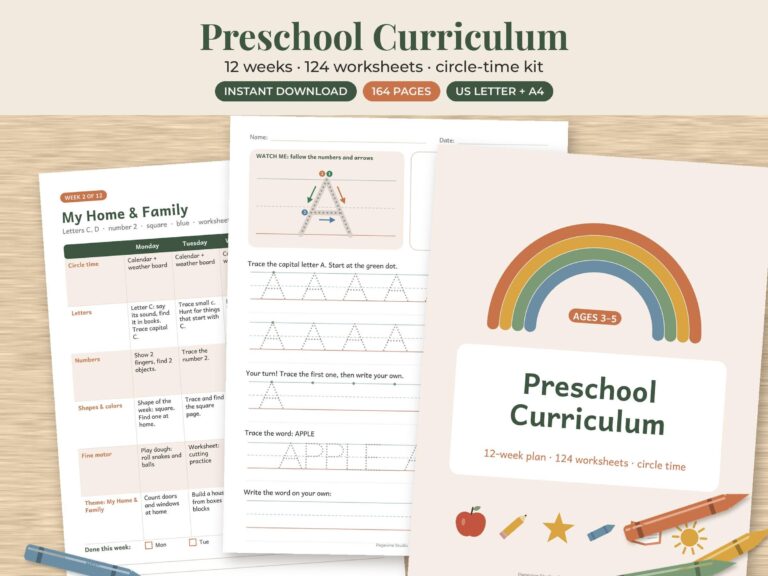
If you’d like more practice pages around the same skills, our kids worksheets and classroom printables cover tracing, early math and more. For a fuller plan for younger learners, the 12-week preschool curriculum bundle lays out letters, numbers and early reading week by week.