Are word searches good for your brain? Yes, in a modest way. A word search gives your attention, visual scanning and word recognition a steady workout, and people who do puzzles regularly tend to score better on thinking tests. What research can’t yet show is that word searches, on their own, prevent memory loss or dementia.
So think of them as one healthy habit, not a cure. Below is what the studies actually found, how word searches compare with crosswords and sudoku, and how to use them well with older adults, including people living with dementia.
The short answer, by question
| Question | What the evidence suggests |
|---|---|
| Do word searches exercise the brain? | Yes. They use focus, visual search, pattern spotting and spelling. |
| Do puzzle fans have sharper thinking? | On average, yes. Large studies link regular puzzling with better test scores. |
| Do puzzles cause that sharper thinking? | Not proven. Sharper people may simply enjoy puzzles more. |
| Do word searches prevent dementia? | No good evidence for that yet. |
| Are they worth doing? | Yes, as an enjoyable, low-cost mental activity alongside exercise and social time. |
What does research say about puzzles and the brain?
Puzzle use and thinking scores
In 2019, researchers in the UK’s online PROTECT study published two papers looking at word puzzles and number puzzles in adults aged 50 and over. With nearly 20,000 volunteers, they found that people who did puzzles more often tended to score better on tests of memory, attention and reasoning.
The catch matters. These were snapshot studies, taken at one point in time. Experts quoted by the UK Science Media Centre’s reaction to the puzzle studies pointed out that the design can’t show cause and effect. One suggested that people with “sharper brains” may just be more likely to want to do puzzles. Another noted the studies can only show that puzzling and thinking skills are linked.
Puzzles and dementia risk over 10 years
A larger, longer study followed 10,318 Australians aged 70 and older for about a decade. Monash University reported that people who regularly did “active” mental activities, such as classes, journaling and crosswords, were 9 to 11% less likely to develop dementia. Crafts and reading were linked to a 7% lower risk.
Again, this shows an association. The researchers said they couldn’t rule out that people drawn to these hobbies have other healthy habits, and the lead author said the activities “may not be a magic pill.”
What dementia charities say
The Alzheimer’s Society’s guide to reducing dementia risk puts it plainly: puzzles are “a great way to maintain a range of thinking skills,” but there’s “not much convincing evidence yet that they have any special effect against dementia compared to other activities.” The same page says staying mentally active helps build cognitive reserve, which helps the brain cope with disease.
What does a word search actually work on?
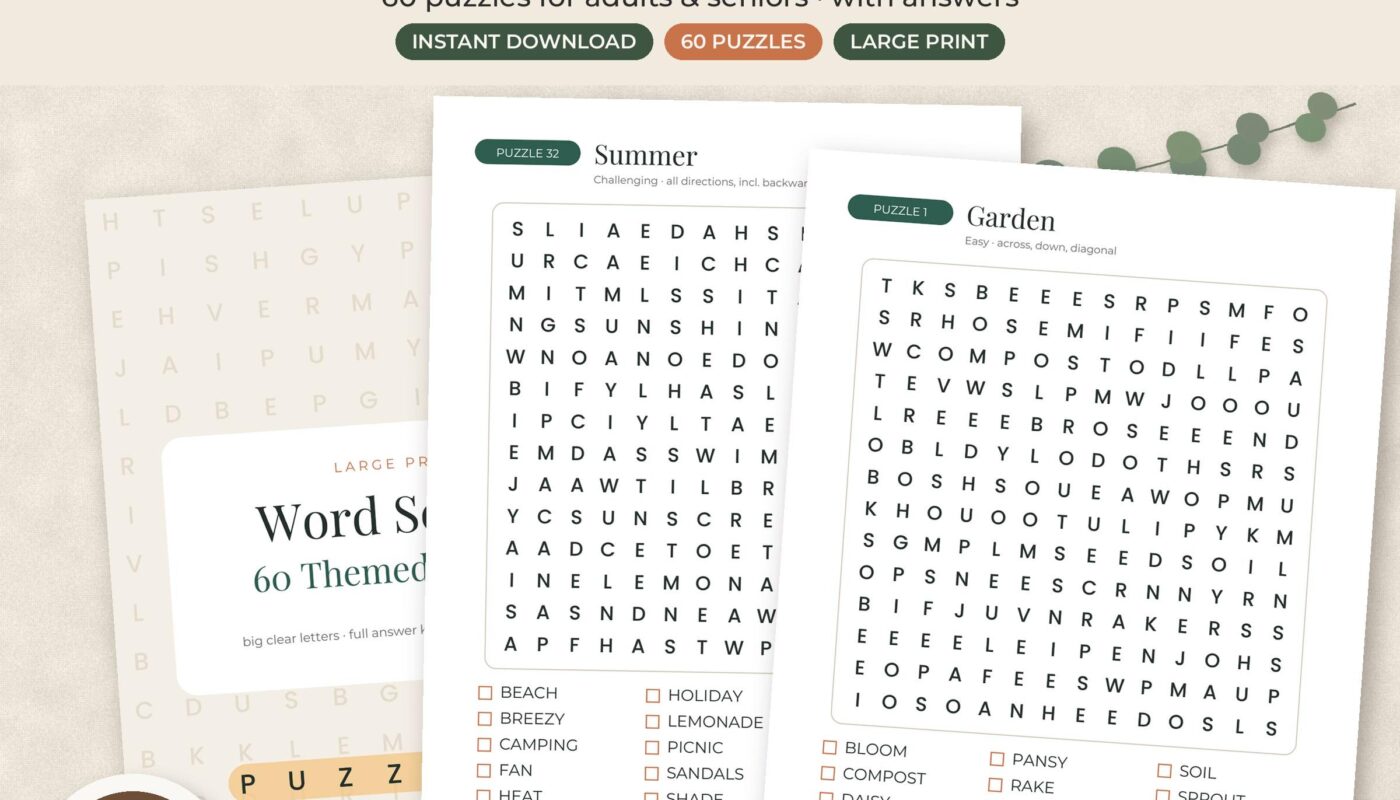
A word search is easy to start, but it isn’t mindless. To find PUMPKIN in a 15 x 15 grid, your brain is doing several jobs at once:
- Sustained attention: staying on task while scanning row after row.
- Visual search: picking a target pattern out of a busy field of letters.
- Working memory: holding the word in mind while your eyes move.
- Spelling and word recognition: spotting PUM and checking if PKIN follows.
- Flexible thinking: switching direction when words run backwards or diagonally.
What a word search doesn’t do much of is recall. You’re given the words, so you’re recognizing, not retrieving. That’s one reason we’d mix it with other puzzle types.
Word search vs crossword vs sudoku: which is better for the brain?
| Puzzle | Main skills | Difficulty to start | Best for |
|---|---|---|---|
| Word search | Attention, visual scanning, spelling | Very easy | Relaxed focus, warm-ups, mixed-ability groups |
| Crossword | Word recall, vocabulary, general knowledge | Medium to hard | Stretching memory and language |
| Sudoku | Logic, planning, working memory | Easy to hard (by level) | Step-by-step reasoning |
| Jigsaw | Visual-spatial skills, patience | Easy to hard | Shared table activity |
No single puzzle wins. The research above points to regular, varied, mentally active hobbies. A practical mix: word searches on low-energy days, sudoku or crosswords when you want a stretch, and something new every few weeks so it stays a challenge.
Are word searches good for seniors?
For most older adults, yes. They’re cheap, quiet, need no screen, and can be picked up for ten minutes or an hour. The big advantage is that they’re easy to succeed at. A puzzle that’s too hard tends to get abandoned. One that’s just right gets done every day, and the “every day” part is what counts.
To keep the challenge going, move up gradually:
- Start with words running only across and down.
- Add diagonal words.
- Add backwards words.
- Try bigger grids or longer word lists.
- Time yourself loosely, then try to beat it next week.
Are word searches good for people with dementia?
Word searches won’t slow the disease, but they can be a calm, meaningful activity that someone with early to middle-stage dementia can still enjoy and finish. A finished puzzle is a small win, and that matters for mood and confidence.
Tips that make it work:
- Go bigger and simpler. Large print, fewer words, and words running only left to right.
- Pick familiar themes. Foods, garden plants, animals, seasons or a hobby they’ve always loved.
- Do it together. Take turns finding words and chat about each one. The conversation is part of the benefit.
- Drop the rules. Circling any word, even one not on the list, is fine. Frustration isn’t the goal.
- Watch the clock. Short sessions of 10 to 20 minutes, earlier in the day, often go better.
If a puzzle starts causing stress, switch to something sensory or simpler, like sorting cards or coloring. Our printable coloring pages are an easy swap.
Why use large print puzzles?
Close-up reading gets harder for almost everyone from middle age, and tiny grids add eye strain on top of the mental work. Large print removes that barrier so the effort goes into the puzzle, not into squinting.
Look for these features in large print puzzles for seniors:
- Letters big enough to read without strain, with clear spacing between them
- Bold, high-contrast black text on white paper
- One puzzle per page, with the word list on the same page
- An answer key for checking
And if reading has become harder lately, it’s worth an eye test. The 2024 Lancet Commission on dementia lists untreated vision loss in later life as one of 14 risk factors it says, if addressed, could prevent or delay nearly half of dementia cases. Hearing loss, high blood pressure, physical inactivity and social isolation are on that list too.
How often should you do word searches?
There’s no proven “dose.” In the PROTECT studies, people who puzzled more often tended to score better, but that doesn’t tell us an ideal amount. Our practical take:
- Little and often beats long and rare. One or two puzzles a day is easier to keep up than a three-hour session once a week.
- Stop before it feels like a chore. If you’re forcing it, switch puzzle type.
- Keep a light challenge. If you’re finishing every grid in under five minutes, move up a level.
Can word searches help you relax?
Many people find them calming. The task is simple enough to settle into, and focusing on a grid gives a busy mind something gentle to hold. That’s a personal experience rather than a treatment, so if worry or low mood is affecting daily life, talk to a doctor.
Make a personal word search
For a parent or grandparent, a custom puzzle can be more engaging than any book. Hide the names of grandchildren, old streets, favorite foods or places they’ve lived. Each word found is a chance to tell a story, and that conversation is good brain exercise too.
What helps the brain more than puzzles?
If you’re doing puzzles mainly for brain health, pair them with the habits that have stronger support. The Alzheimer’s Society calls regular physical activity “one of the best ways to reduce your risk of dementia,” and notes that social activity is a great way to keep the brain working, especially in older age.
A balanced week for an older adult could look like this:
| Day | Body | Mind | People |
|---|---|---|---|
| Monday | 20-minute walk | Word search | Phone a friend |
| Tuesday | Chair exercises | Sudoku | Coffee with a neighbor |
| Wednesday | Gardening | Crossword | Puzzle swap with family |
| Thursday | 20-minute walk | Learn something new (a recipe, a craft) | Community class |
| Friday | Stretching | Word search, harder level | Do a puzzle together |
Check with a doctor before starting a new exercise routine, especially after illness or a fall. This is general information, not medical advice.
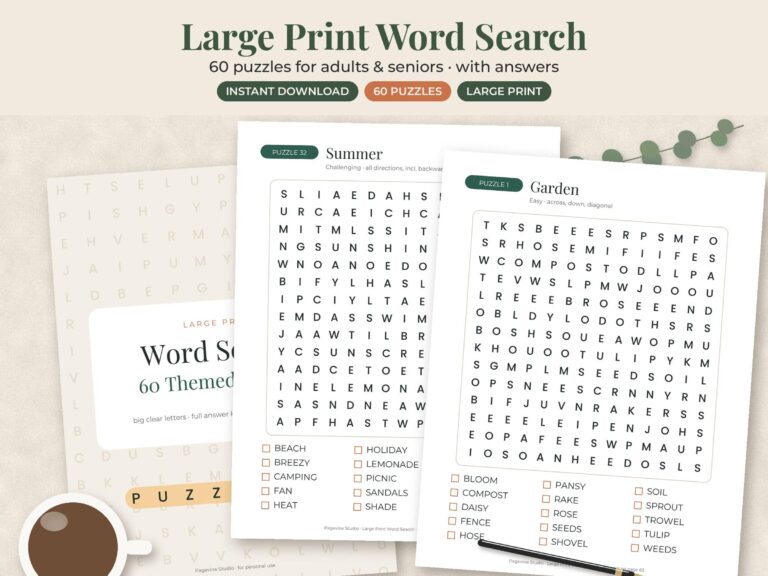
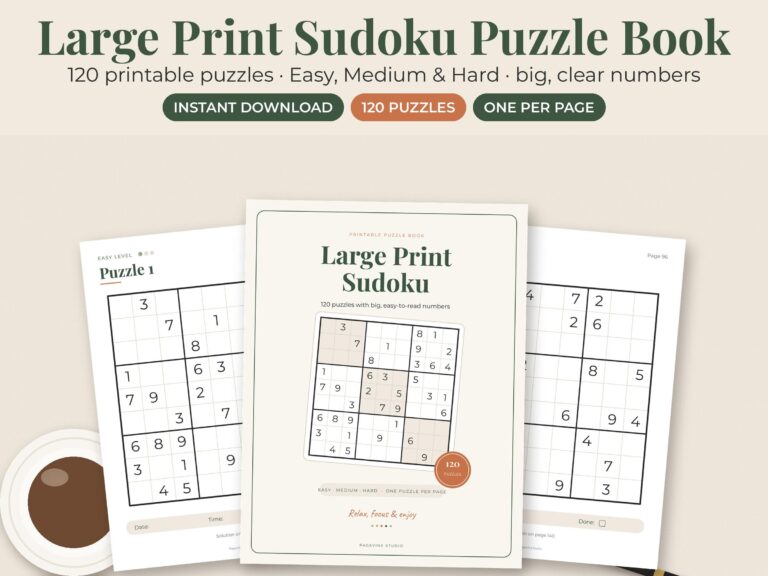
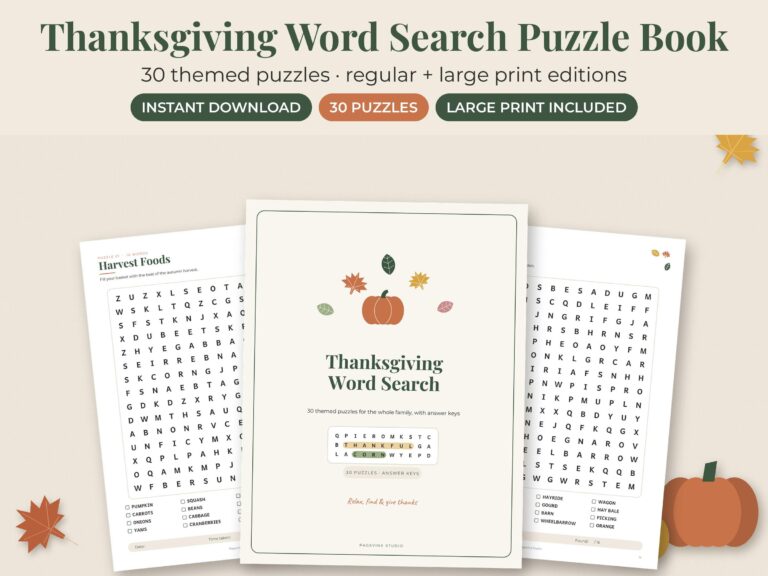
If you’d like printable puzzles that are easy on the eyes, the large print word search puzzle book and large print sudoku puzzle book make a simple daily mix. For a seasonal theme in November, there’s a large print Thanksgiving word search, and more in our large print puzzles and activities collection.