Good habit tracker ideas have three things in common: they’re small, you do them most days, and you can answer them with a simple yes or no. “Walk 20 minutes” works. “Get healthy” doesn’t.
Below are 50 habits to track in 2027, grouped so you can pick three to five that fit your year. After the list, you’ll find what research says about how long habits take, whether trackers work, and how many habits to track at once.
How to pick habits worth tracking
Before you scan the list, run each idea through three quick tests:
- Is it an action, not a result? “Drink 6 glasses of water” is an action. “Lose 10 pounds” is a result. Track actions.
- Can you do it on a bad day? If not, shrink it. “Read 5 pages” beats “read for an hour.”
- Does it connect to something you want this year? A habit with a reason lasts longer than one copied from someone else’s list.
The habit tracker ideas list: 50 habits for 2027
Health and movement (10)
- Walk at least 20 minutes
- Strength exercise (two set days a week)
- Drink a glass of water before each meal
- Eat a vegetable with lunch and dinner
- Stretch for 5 minutes
- Take the stairs
- Pack lunch from home
- Stand up and move every hour at work
- Take any prescribed medicine on time
- Get outside in daylight before noon
A useful benchmark for the movement habits: the CDC says adults need 150 minutes of moderate activity a week and at least 2 days of muscle-strengthening activity. A 30-minute walk on five days covers the first part, which makes “walk 30 minutes” a very trackable habit. A weekly workout planner and gym log handles the strength side.
Sleep and daily routine (8)
- Lights out by a set time
- No phone in bed
- Wake up at the same time, weekends included
- Make the bed
- Lay out tomorrow’s clothes
- Write tomorrow’s top 3 tasks
- No caffeine after 2 p.m.
- Screen-free first 30 minutes of the day
Money (8)
- Log every purchase
- No-spend day
- Check your bank balance
- Move a set amount to savings
- Cook dinner instead of ordering
- Wait 48 hours before any non-essential buy
- Bring coffee from home
- Review one subscription a week
Home (8)
- Ten-minute tidy before bed
- Run the dishwasher or wash the dishes before bed
- One load of laundry, start to finish
- Clear one surface
- Plan the week’s meals on a set day
- Water the plants
- Declutter one item
- Open the mail the day it arrives
Habit tracker ideas for students (8)
- Review class notes for 15 minutes
- Start homework before a set time
- Pack your bag the night before
- Read 10 pages of a book you chose
- Phone in another room while studying
- Check your planner for deadlines
- Practice flashcards for one subject
- Ask one question in class
Mind, learning and people (8)
- Write one line in a journal
- Note three things you’re grateful for
- Read for 20 minutes
- Practice a language for 10 minutes
- Message a friend or family member
- Five minutes of quiet breathing
- Learn one new word
- One kind act for someone else
How long does it take to form a habit?
Longer than the “21 days” you may have heard. In a well-known University College London study, researchers followed people as they built one new daily health habit. UCL reported that it took an average of 66 days to form a new habit.
The range was wide. A summary from the British Psychological Society notes that individual times ranged from 18 days to a predicted 254 days. Exercise habits took about one and a half times as long to settle as eating or drinking habits.
The encouraging part: missing a single day did not significantly set people back. Many missed days did. So the goal isn’t a perfect streak. It’s “never miss twice.”
What that means for your 2027 tracker
- Plan to track a new habit for at least two to three months before judging it.
- Starting on January 1, 66 days takes you to early March.
- Pick easy habits first. They become automatic sooner and free up energy for harder ones.
Do habit trackers actually work?
The research on tracking progress is positive. The American Psychological Association reported on a review of 138 studies with nearly 20,000 participants. People who monitored their progress were more likely to reach their goals, and the more often they monitored, the better their chances.
Two details matter for habit trackers:
- Writing it down helped more. Monitoring had a bigger effect when progress was physically recorded or publicly reported.
- Track the right thing. Tracking a behavior (like what you eat) changed the behavior. Tracking an outcome (like weight) changed the outcome. Pick the one you actually want to move.
A tracker won’t do the habit for you. What it does is make each day visible, which is often enough to nudge you into doing the small thing.
How many habits should you track at once?
Our view: three to five. Beginners should start with three.
Every habit takes a little attention. Track ten new habits in January and you’ll likely drop most of them by February. Track three, and once they feel automatic, add one more. By the end of 2027 you could have a dozen solid habits instead of a dozen abandoned ones.
| Your situation | How many to track | Example mix |
|---|---|---|
| First time using a tracker | 3 | Walk 20 minutes, lights out by 11, log spending |
| Some habits already stick | 4 to 5 | Add read 20 minutes and a 10-minute tidy |
| Student in exam season | 3 to 4 | Review notes, phone in another room, sleep by a set time |
| Busy parent | 3 | Water before meals, plan meals on Sunday, 5-minute stretch |
A sample tracker for January 2027
Here’s how a first month could look for someone who wants more energy and less money stress. January 2027 starts on a Friday, so the first “week” is only three days. That’s fine. Use it as a warm-up.
| Habit | Cue | Small version for bad days |
|---|---|---|
| Walk 20 minutes | Right after lunch | Walk around the block once |
| Lights out by 11 p.m. | Phone on the charger at 10:30 | Lights out by 11:30 |
| Log every purchase | When you put your card away | Note the total at the end of the day |
The “small version” column is the secret. On a rough day you still get to tick the box, and your streak stays alive. Over time, the full version becomes the normal one.
What to do when you miss a day
You will miss days. Everyone does. Here’s how to handle it without giving up:
- Never miss twice. One gap is noise. Two in a row is the start of a new habit, the wrong one.
- Don’t “make up” the habit. Walking 40 minutes tomorrow to cover today teaches your brain the habit is optional.
- Look for the pattern. If you always miss on Wednesdays, the problem is Wednesday, not you. Change the cue or the time.
- Shrink it for a week. If a habit keeps failing, cut it in half until it sticks again.
Habit tracker ideas for a bullet journal
If you like drawing your own pages, these layouts work well:
- Classic grid: habits down the left, days 1 to 31 across the top. Fill a square each day.
- Circle tracker: a ring split into 31 slices per habit. It looks good and shows gaps clearly.
- Weekly strip: seven boxes under each habit on your weekly spread. Easier if your monthly pages get crowded.
- Year in pixels: one tiny square per day for a single habit across all of 2027.
Keep the key simple: filled for done, a dot for a planned rest day, blank for missed.
What is a good habit tracker for beginners?
The best tracker is the one you’ll see every day. For most beginners that’s a printed monthly grid on the fridge, desk or inside a planner.
- Write three habits in the left column. Keep the wording short and specific.
- Tie each one to a cue, like “after I brush my teeth” or “when I get home.”
- Tick it the moment you finish, not at the end of the day.
- Review on the last day of the month. Keep what worked, shrink what didn’t, and add one new habit if the others feel easy.
Pair your habits with bigger goals for the year. A 2027 year planner printable helps you see where each habit fits across the months.
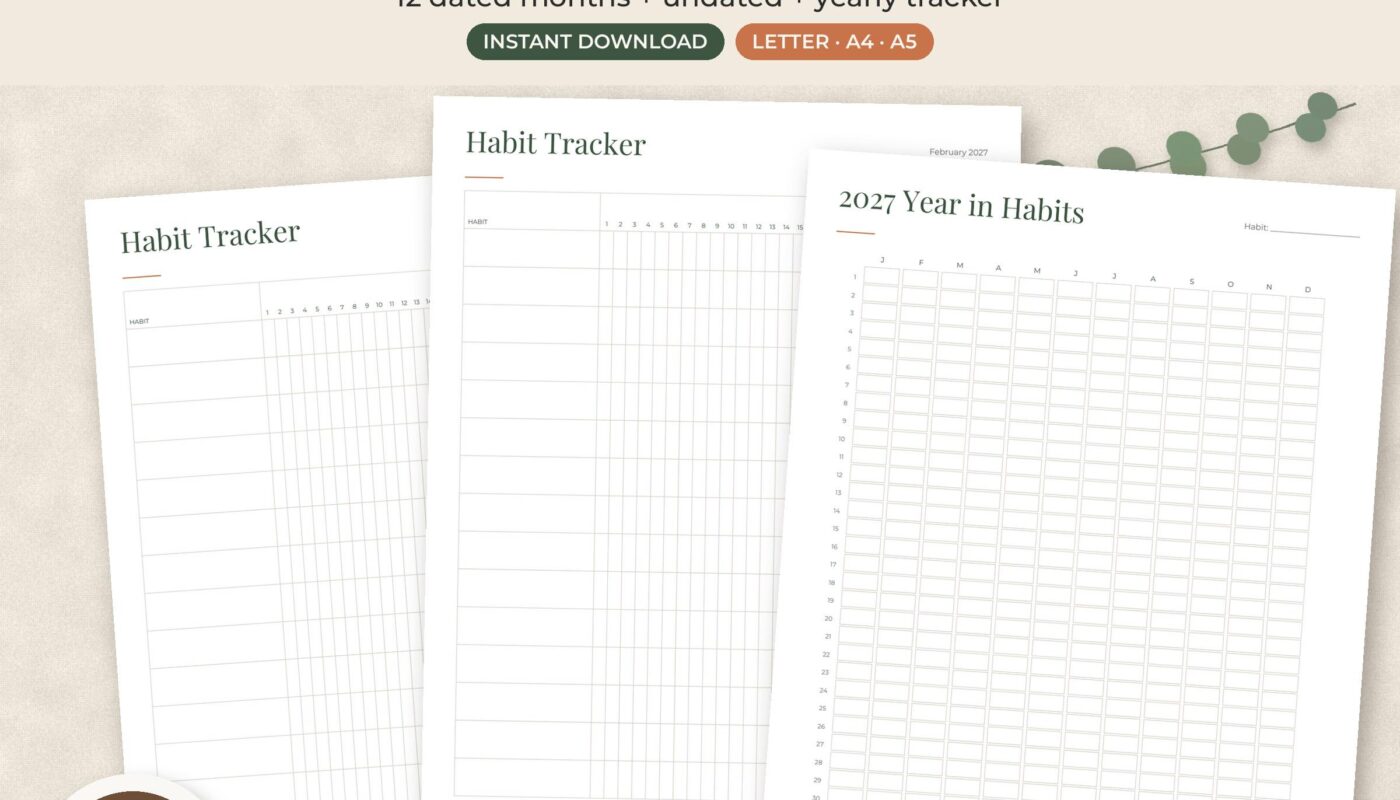
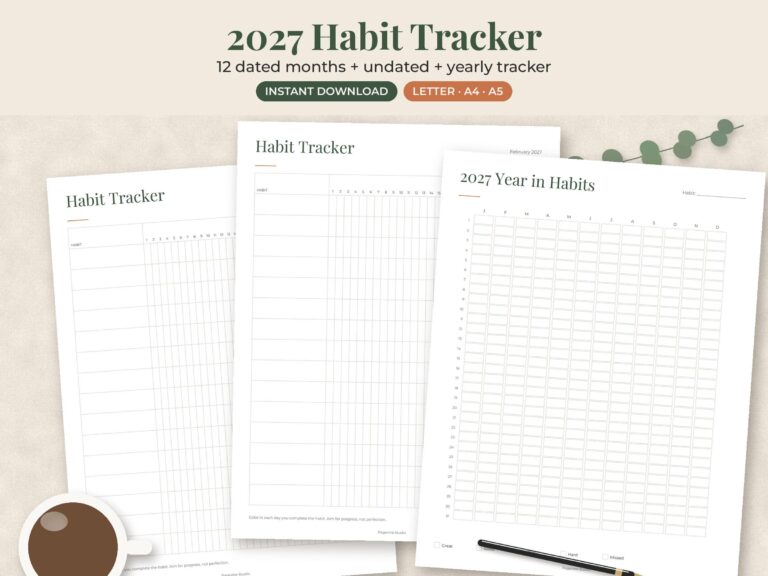
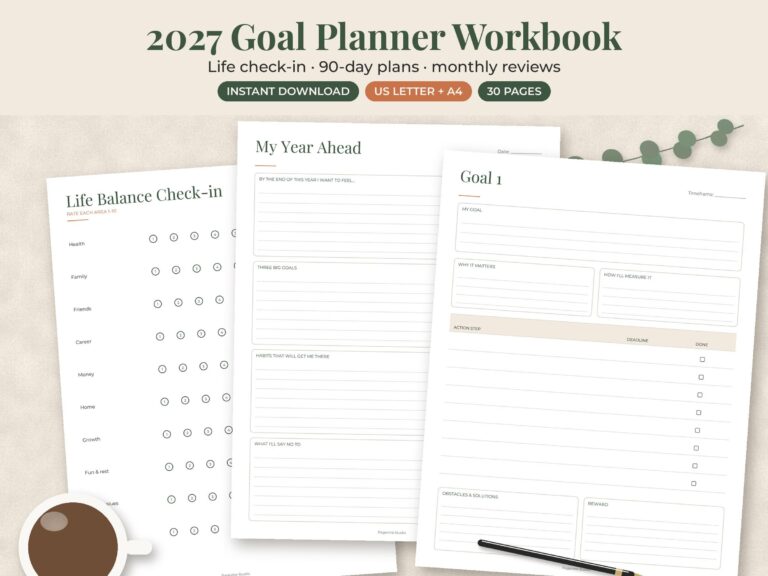
If you’d like a ready-made layout, the 2027 monthly habit tracker has a page for every month, and the 2027 goal-setting workbook helps you choose which habits to start with.