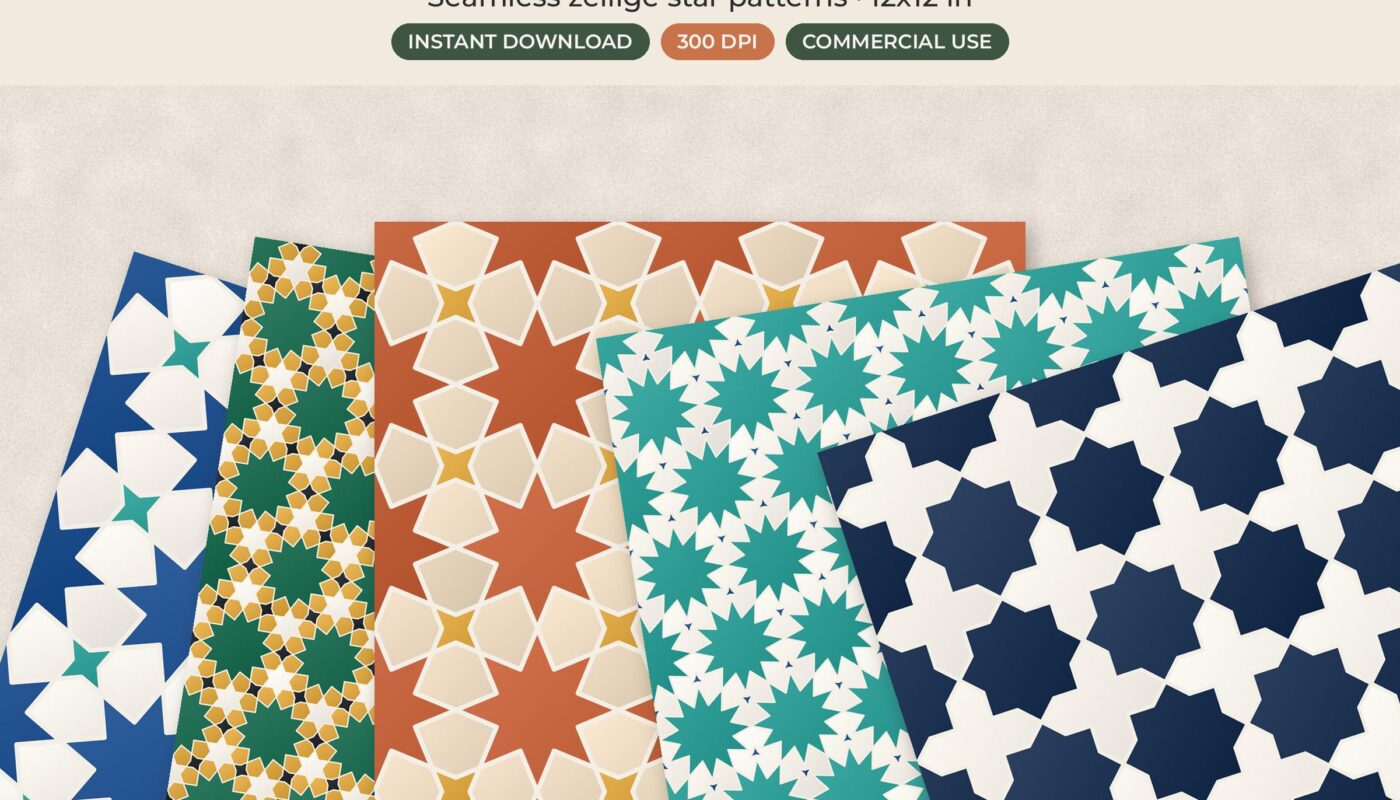
Zellige tile patterns are the geometric mosaics of Morocco: stars, interlacing bands and polygons made from small, hand-cut pieces of glazed clay tile. Each piece is cut to shape and fitted with the others like a puzzle, so even a small panel is made of many separate pieces. The patterns themselves are built from simple geometry, starting with a circle and a straight line.
This guide covers where zellige comes from, the classic Moroccan zellige tile patterns, how you can draw one yourself, and how to use zellige-style digital paper for printing and crafts.
What is zellige tile?
Zellige (also spelled zellij) is a traditional Moroccan craft. The Museum of Ethnography in Budapest, in its 2026 zellige exhibition, describes it as “glazed terracotta pieces assembled into intricate mosaics” and one of Morocco’s oldest decorative arts. The craft involves three main stages: preparing and firing the clay, cutting the tiles precisely by hand, and assembling the pieces into patterns.
Two things make real zellige look the way it does:
- Hand-cut pieces. Every star, triangle and bow-tie shape is cut individually, so edges are never perfectly machine-straight.
- Uneven glaze. Small variations in color and surface catch the light differently, which gives a zellige wall its shimmer.
That slight imperfection is part of the appeal. It’s also something good zellige-style digital paper tries to capture with subtle texture rather than flat, flawless color.
A short history of zellige
| Period | What happened |
|---|---|
| Late antiquity | Interlaced shapes and geometric ornament were already used by Greek, Roman and Sasanian artists. |
| Early Islamic period | Islamic artists adopted and expanded these forms into a style built on unity and order, helped by the work of mathematicians and astronomers. |
| 10th century | Zellige originated in the city of Fez, starting with simpler geometric patterns. |
| Marinid and Saadian eras | The craft reached richly decorated palaces and mosques. |
| 20th century | Zellige was rediscovered and revived. |
| Today | It continues to inspire architecture, interiors and graphic design worldwide. |
The early history comes from the Metropolitan Museum of Art’s essay on geometric patterns in Islamic art; the Moroccan timeline is from the Museum of Ethnography exhibition notes.
What are traditional Moroccan zellige patterns?
The Met groups the building blocks of Islamic geometric design into four types: circles and interlaced circles, squares and four-sided shapes, star patterns, and multisided polygons. Zellige uses all of them. The motifs you’ll see most often:
| Pattern | What it looks like | Where you’ll see it |
|---|---|---|
| 8-point star | Two squares overlapped, one turned 45 degrees | The most recognizable Moroccan geometric pattern |
| Star and cross | 8-point stars alternating with cross shapes, tiling with no gaps | Floors, walls, fountain surrounds |
| Rosettes (12- and 16-point) | A large central star with petal-like shapes radiating out | Feature panels and focal points |
| Interlacing bands | Straps that weave over and under each other | Borders and frames |
| Simple squares and chevrons | Single-color square tiles laid in grids or herringbone | Modern kitchens and bathrooms |
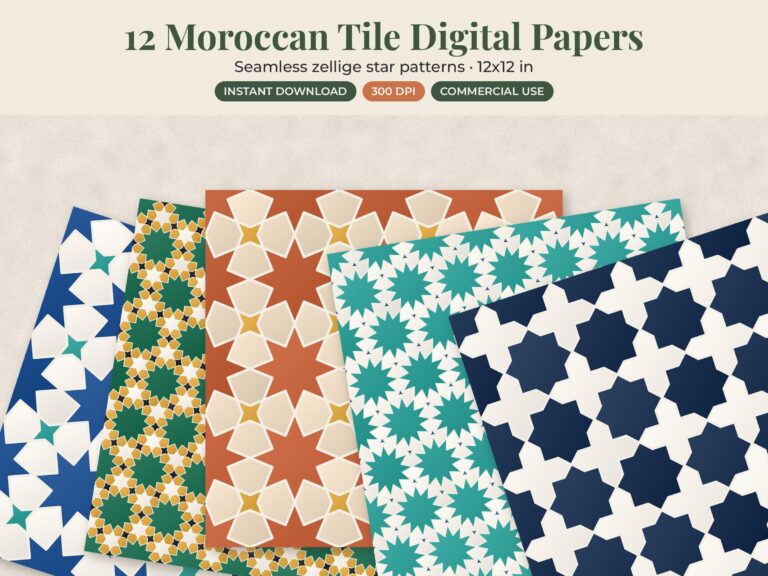
Color often follows a few traditional families: deep blues, greens, white, ochre and black. Modern designers also use soft neutrals and blush tones, which work well for wedding stationery and planners.
How are Islamic geometric patterns made?
With just two tools. A University of Toronto teaching handout on Islamic art, drawing on the Met’s education materials, notes these patterns were constructed with a compass and a ruler, and that most are derived from a grid of polygons. The circle and the line are the base of everything.
The Met adds that the star pattern is “ultimately derived from squares and triangles inscribed in a circle.” Because the units repeat, a pattern can be extended in every direction, which is why it can cover a small box or an entire courtyard.
Draw a simple 8-point star in 6 steps
You’ll need a compass, a ruler and a pencil. It takes about ten minutes.
- Draw a circle. Any size; 3 inches across is easy to work with.
- Draw a cross. One line straight across the center, one straight down, both touching the circle’s edge.
- Add the diagonals. Draw two more lines through the center, halfway between the first two. You now have 8 points around the circle.
- Join every other point. Connect points 1, 3, 5 and 7 to make a square.
- Join the remaining points. Connect points 2, 4, 6 and 8 for a second square, turned 45 degrees.
- Erase the extra lines. The outline of the two overlapping squares is your 8-point star.
Copy that star across a grid, fill the gaps with cross shapes, and you’ve made the classic star-and-cross tiling. Kids enjoy this one too, and it doubles as a neat geometry lesson.
Choosing a zellige color palette for your project
The same star pattern can feel bold or calm depending on color. Some combinations we like:
| Palette | Mood | Works well for |
|---|---|---|
| Cobalt blue, white, touch of green | Classic, fresh | Kitchen prints, coasters, notebooks |
| Emerald, ochre, cream | Warm, rich | Gift boxes, autumn table cards |
| Terracotta, sand, soft white | Earthy, relaxed | Living room prints, planner covers |
| Sage, blush, ivory | Soft, modern | Wedding stationery, nursery decor |
| Black, white, gold | Formal, graphic | Invitations, certificates, menus |
A simple rule: let one color lead, use a second for the star shapes, and keep the background light so any text on top stays easy to read.
What is digital paper used for?
Digital paper is a pattern or texture sold as a downloadable image file, usually a JPG or PNG. Instead of buying a pad of patterned paper, you print the designs yourself, as many times as you need, or use them on screen.
Common uses:
- Scrapbooking and card making: backgrounds, mats and envelope liners.
- Planners and journals: covers, dividers and dashboard pages.
- Gift wrap and packaging: small gift boxes, tags and bag toppers.
- Party and event stationery: invitation backings, menu borders and place cards.
- Home decor: drawer liners, framed pattern prints and shelf backing.
- Digital design: social media graphics, blog headers and slide backgrounds.
- Classroom projects: geometry displays and pattern-spotting activities.
Moroccan digital paper is especially useful for event stationery and home projects because geometric patterns feel elegant without being busy, and they pair well with plain text.
Can I use digital paper for printing and crafts?
Yes, that’s what it’s made for. A few tips get you better results:
Printing tips
- Check the size and resolution. Digital papers are often made at 12 x 12 inches and 300 DPI, which prints sharply. Printing smaller is fine; printing much larger can blur.
- Choose your paper. Cardstock (65 to 110 lb) for cards and boxes, matte photo paper for framed prints, plain printer paper for practice runs.
- Print a test square first. Screen colors and printed colors rarely match exactly. Deep blues and greens are the ones most likely to shift.
- Use “fit to page” carefully. On US Letter (8.5 x 11 inch) or A4, a 12 x 12 inch design will be cropped or scaled. Decide which part of the pattern you want to keep.
- Use a high-quality print setting for dense patterns so lines stay crisp.
Check the license
Personal projects are almost always allowed. Selling items you make with digital paper, like printed cards or tumblers, depends on the seller’s terms. Read the license in the listing before you sell anything, and never resell the digital files themselves.
Five zellige-inspired project ideas
- Tile-look coasters. Print a star pattern, cut squares to fit cork coasters, and seal with a decoupage medium.
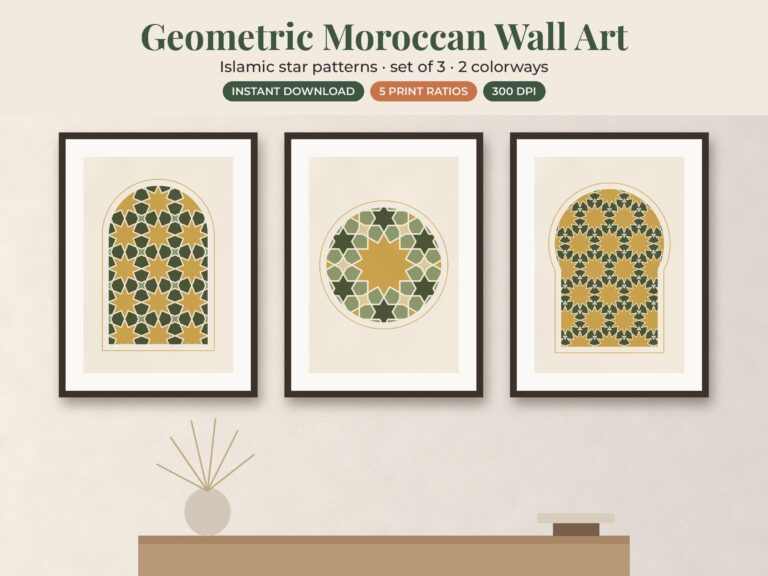
- Gallery wall trio. Frame three related patterns in matching frames. A ready-made option is the Moroccan geometric prints set of 3.
- Planner cover. Print a zellige pattern on cardstock and laminate it as a sturdy cover for a printable 2027 year planner.
- Gift boxes. Print on cardstock, fold into small boxes for sweets or jewelry, and finish with a plain tag.
- Invitation backing. Layer a printed text card on top of a patterned panel for a simple, elegant invitation.
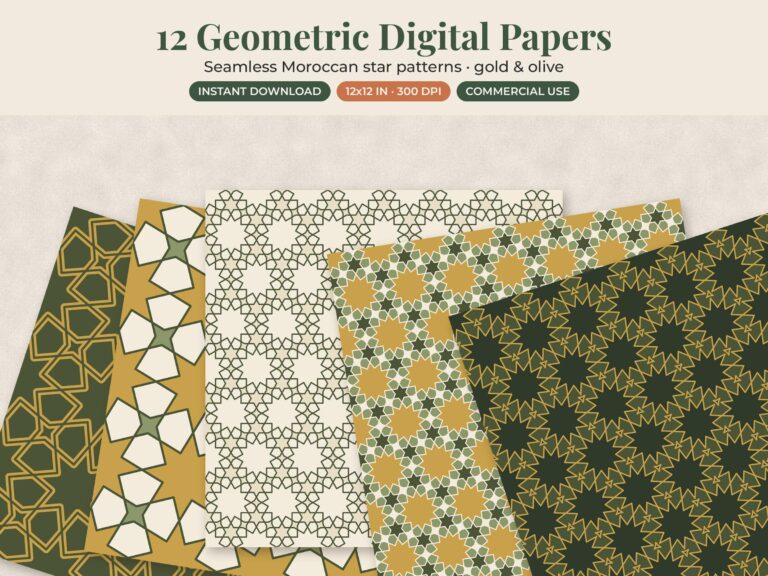
If you want patterns ready to print, our Moroccan zellige tile digital paper is inspired by traditional tile designs, and the Moroccan star geometric digital paper features star-based geometric designs. You’ll find more in our clipart, SVG and digital paper collection.