
A wedding planning checklist works best as a timeline. Set your budget and guest count first, book the venue 12 or more months out, lock in your main vendors by 9 months, send invitations 6 to 8 weeks before, and spend the final week confirming details instead of starting new jobs. Below is the full month-by-month list, from the first conversation to the week of the wedding.
Got less than a year? Start at the top anyway and do the first two stages in your first month. The order matters more than the exact dates.
The wedding planning timeline at a glance
| When | Main jobs |
|---|---|
| 12+ months out | Budget, guest list draft, date range, venue |
| 10 to 11 months | Photographer, caterer, officiant, planner |
| 8 to 9 months | Attire, wedding party, florist, website |
| 6 to 7 months | Save-the-dates, rentals, cake, transport |
| 4 to 5 months | Invitations ordered, menu, rings, hair and makeup |
| 2 to 3 months | Mail invitations, fittings, day-of timeline |
| 1 month | RSVPs, final headcount, seating, marriage license |
| Week of | Confirm, pay balances, deliver items, rest |
12 or more months out: budget, guests and venue
1. Agree on your top three priorities
Sit down together and each pick three things you care about most, like the food, the photos or having every cousin there. Where your lists overlap is where the money goes first. Everything else can be simpler.
2. Set your wedding budget
Do this before you tour a single venue. Add up savings you can spend, what you can save each month until the wedding, and any family gifts that are confirmed with an amount. Then keep 5 to 10% aside for surprises.
For context, the average US wedding cost $34,200 for couples married in 2025, with 117 guests on average, according to The Knot 2026 Real Weddings Study. Plenty of weddings cost far less. Our guide on how much a wedding costs and how to set a budget walks through the math with a worked example.
Here’s a starting split. The averages are The Knot’s figures for couples who paid for each item, so they won’t add up to the total.
| Category | Share of budget | On a $30,000 budget | US average (The Knot) |
|---|---|---|---|
| Venue and catering | 45 to 50% | $13,500 to $15,000 | Venue $12,900; catering $80 per person |
| Photography and video | 10 to 12% | $3,000 to $3,600 | Photo $3,000; video $2,300 |
| Flowers and decor | 8 to 10% | $2,400 to $3,000 | Flowers $2,800; lighting and decor $1,900 |
| Attire, hair and makeup | 8% | $2,400 | Dress $2,100; hair $150; makeup $150 |
| Rings | 5% | $1,500 | $3,000 |
| Planner or day-of coordinator | 4 to 5% | $1,200 to $1,500 | $2,100 |
| Rentals | 4% | $1,200 | $2,000 |
| Stationery, cake and favors | 4% | $1,200 | Stationery $510; cake $540; favors $480 |
| Transport, officiant, fees and tips | 4% | $1,200 | Transport $1,100; officiant $260 |
| Unplanned extras | 5% | $1,500 | n/a |
If venue and catering climb past half your budget, something else has to shrink. This is general information, not financial advice.
3. Draft the guest list
Write every name you might invite, then sort into “must,” “should” and “nice.” Guest count drives the venue size and the catering bill more than anything else. At The Knot’s average of $292 per guest, cutting 20 names saves roughly $5,800.
4. Pick a date range and book the venue
Choose two or three possible dates, then tour venues. Ask what’s included (tables, chairs, linens, catering), the guest limit, the deposit and the cancellation terms. Get the contract in writing before you pay.
5. Start one place to track everything
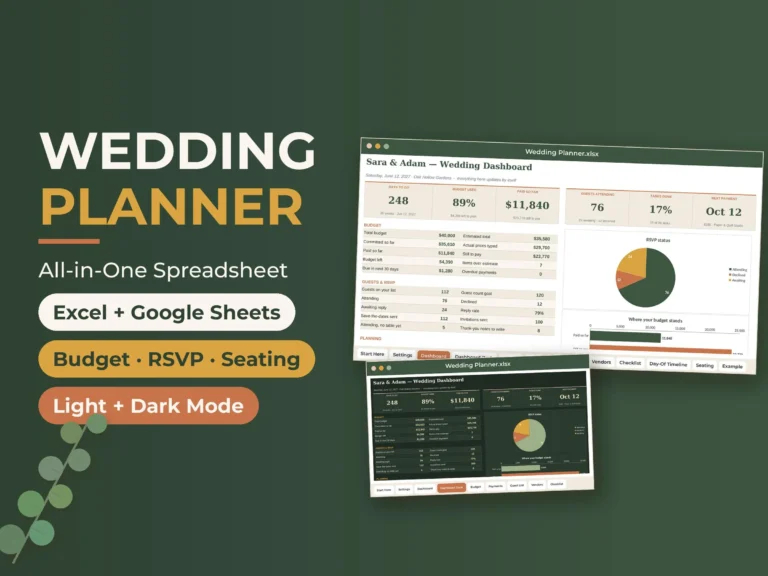
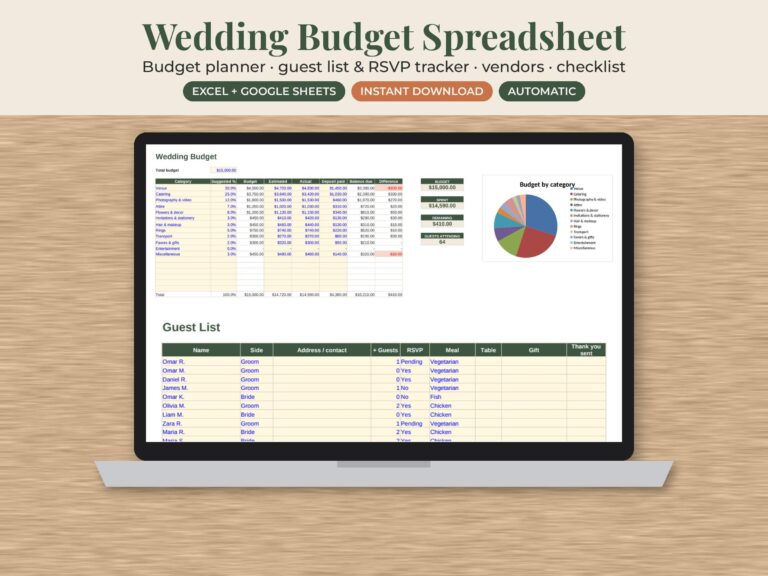
One spreadsheet or binder for budget, guests, vendors and tasks saves hours of searching emails later. Set it up now, while there are only a few entries. A wedding budget spreadsheet that tracks estimated, actual and paid amounts is the bare minimum.
10 to 11 months out: book the key vendors
Popular vendors book up first, so lock in the ones you care about most.
- Photographer and videographer. Look at full galleries, not just highlight posts. Ask how many hours are included and when you’ll get the photos.
- Caterer, if your venue doesn’t include one. Ask for a tasting date and a per-person quote that includes staff and service fees.
- Officiant. Confirm they’re allowed to perform marriages in your state.
- Planner or day-of coordinator. Even a coordinator for the last month takes a lot off your plate.
- Hotel room block if many guests are traveling.
Write each deposit and balance due date in your tracker the day you sign. Missed balance dates are one of the most common last-month stresses.
8 to 9 months out: attire, wedding party and florist
6. Shop for wedding attire
Ordered dresses can take several months to arrive, then need fittings. Starting now leaves room for that. Set an attire budget before your first appointment, and bring only one or two people.
7. Ask your wedding party
Ask in person or by phone, and be clear about what you’ll expect and what it might cost them.
8. Book the florist and build a wedding website
Bring photos you like and your budget number to the florist. Then set up a simple website with the date, location, travel details and the registry link once you have one.
6 to 7 months out: save-the-dates, rentals and cake
- Send save-the-dates. Zola’s guide on wedding invitation timing suggests 4 to 6 months out, and 10 to 12 months for a holiday weekend or a far-off location.
- Book rentals the venue doesn’t supply: tables, chairs, linens, lighting, a tent if you’re outdoors.
- Schedule a cake tasting and order the cake or dessert table.
- Book transport for you and, if needed, a shuttle for guests.
- Set up your registry. Add items at a range of prices.
- Plan the honeymoon, if you’re taking one soon after. Check passport expiry dates now.
4 to 5 months out: invitations, menu and rings
9. Order invitations
Order now so printing and addressing don’t get rushed. Include an RSVP card or a website link, and order 10 to 15 extras for mistakes and keepsakes. An editable set like the minimalist wedding invitation set lets you print at home or at a local print shop.
10. Finalize the menu and drinks
After the tasting, confirm meal choices, dietary options and drinks or beverages with your caterer. Ask when the final headcount is due; it’s often two to three weeks before.
11. Buy rings and book hair and makeup
Rings may need sizing or engraving, which takes time. Book hair and makeup with a trial run about a month or two before the day.
2 to 3 months out: mail invitations and plan the day
- Mail invitations 6 to 8 weeks before the wedding. That’s the standard window in Zola’s guide. Add a few weeks if many guests live abroad.
- Book fittings and leave time between the last one and the wedding.
- Write a day-of timeline: when the photographer arrives, ceremony start, meal, speeches, end time.
- Check marriage license rules with your county clerk’s office. Requirements, fees and waiting periods vary by state, so find out how early you can apply.
- Buy favors, guest book and signs.
- Plan the rehearsal dinner, if you’re having one.
1 month out: RSVPs, headcount and seating
Zola suggests setting your RSVP deadline about one month before the date. That gives you time to chase the people who didn’t reply.
- Follow up on missing RSVPs by text or phone.
- Send the final headcount and meal counts to your caterer.
- Make the seating chart. Group by how guests know you, and keep anyone who doesn’t get along at different tables.
- Get the marriage license within the window your state allows.
- Send the day-of timeline to every vendor and the wedding party.
- List every balance still due, with dates and amounts.
2 weeks out to the week of the wedding
12. Confirm every vendor
Call or email each vendor with the address, arrival time and a day-of contact who isn’t you. Ask the person running the day to hold the vendor list.
13. Pack the emergency kit and the “venue box”
Kit: safety pins, sewing kit, stain wipes, pain relievers, snacks, phone chargers. Box: signs, guest book, favors, place cards, the rings and the license. Label it and hand it to one trusted person.
14. Pay balances and prepare tips
Put tips in labeled envelopes and give them to your coordinator to hand out.
15. Rest the day before
Don’t start new projects in the last 48 hours. If something isn’t done, it probably won’t be missed.
After the wedding
- Send thank-you notes, ideally within a few months.
- Return rentals and borrowed items on time to get deposits back.
- If you’re changing your name, start with Social Security. You may be able to request the name change online, and the new card arrives about 5 to 10 business days after the request is processed.
- Close out your budget so you know where the money went.
Keep your wedding planning checklist in one place
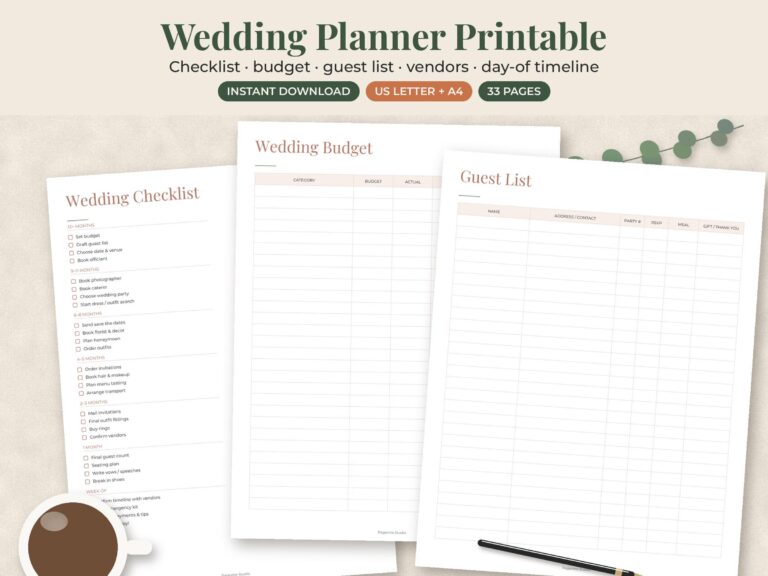
Paper or spreadsheet, the key is one source for tasks, money and guests. If you want a ready-made version, the wedding planner spreadsheet has an 87-task checklist that sets due dates from your wedding date, plus budget, guest list, vendor and seating tabs. Prefer paper? The 45-page printable wedding planner binder covers the same ground.