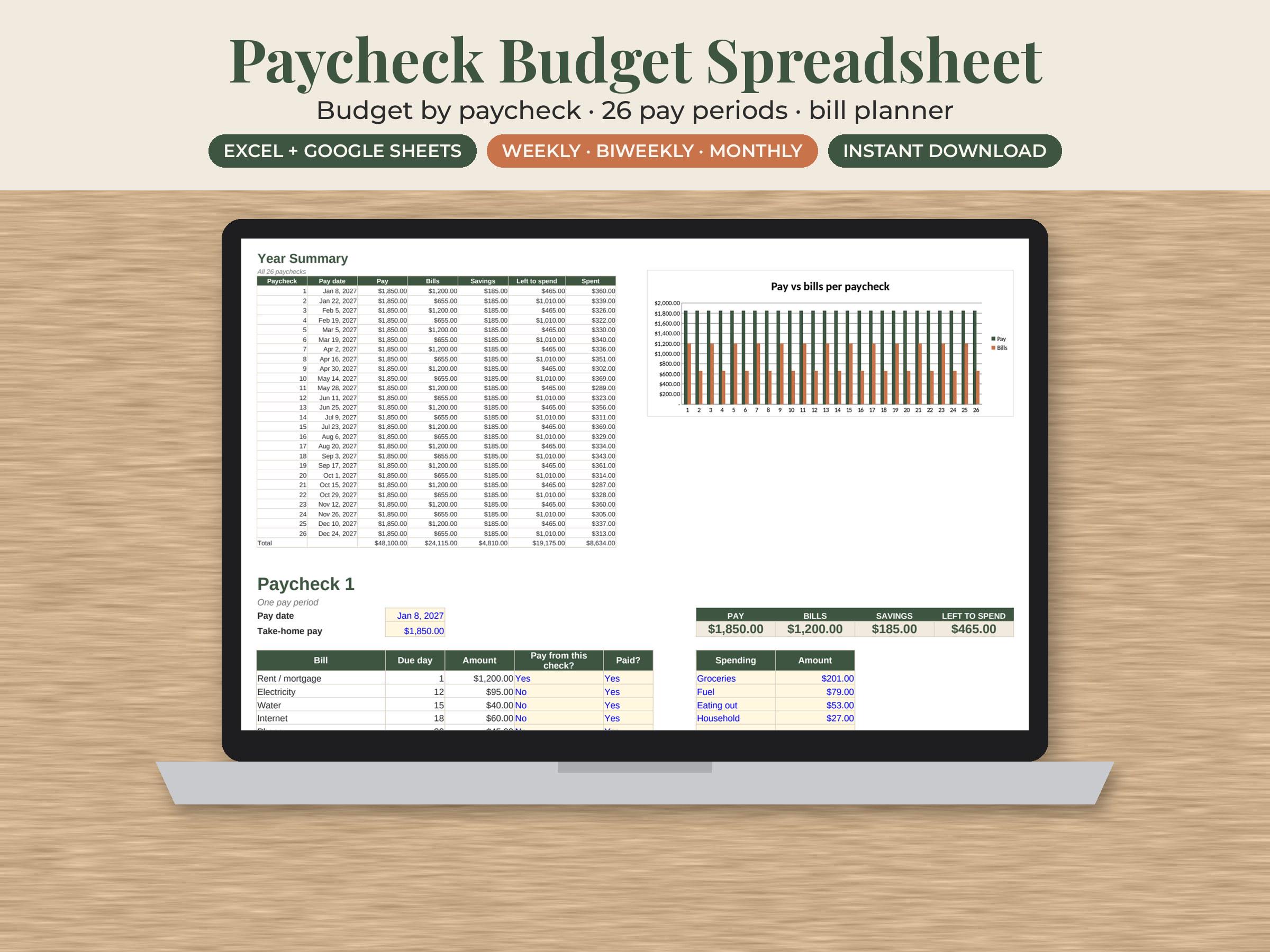
Here is how to budget biweekly paychecks in one line: build your monthly budget on two paychecks, assign every bill to the paycheck that lands before its due date, and treat the two “extra” paychecks each year as planned bonus money.
That works because 26 paychecks don’t divide evenly into 12 months. Most months you get two. Twice a year, you get three. Below is the step-by-step method, a worked example with real numbers, and a table of three-paycheck months in 2027.
Why biweekly pay feels harder to budget
Your bills are monthly. Your pay is every 14 days. So your paydays drift a little earlier each month, and the money doesn’t always arrive when rent is due.
A common shortcut is to take yearly pay and divide by 12. The government’s consumer.gov budget guide suggests exactly that for people who aren’t paid monthly: add up a year’s income and divide by 12. It’s a fair way to see the big picture. The catch: 26 divided by 12 is about 2.17 paychecks a month, and in 10 months of the year you only get two. If you budget on the average, you’ll come up short in most months.
That’s why we’d budget on two paychecks a month and let the extra checks be a bonus.
How to budget biweekly paychecks in 6 steps
- Use your real take-home pay. Check your last two pay stubs. Use the amount that lands in your account after taxes, insurance and retirement.
- List every bill with its due date. Rent, car, phone, utilities, insurance, debt payments, subscriptions. Write the due day next to each one.
- Split the month in two. Paycheck 1 covers bills due from the 1st to the 14th. Paycheck 2 covers bills due from the 15th to the end of the month.
- Split big bills in half. Rent or a mortgage is usually too big for one check. Set aside half from each paycheck so the full amount is ready on the due date.
- Divide flexible spending per paycheck. Groceries, gas and personal spending get a two-week amount, not a monthly one. Two-week numbers are easier to stick to.
- Give every dollar a job, then check the balance. Each paycheck should reach zero after bills, flexible spending and savings. If one check runs short, move a bill (more on that below).
A worked example: a $1,450 biweekly paycheck
Say your take-home pay is $1,450 every two weeks. On paper that’s $37,700 a year. For budgeting, you plan on $2,900 a month (two checks).
Your bills look like this: rent $1,200 on the 1st, car payment $310 on the 10th, phone $65 on the 12th, subscriptions $25 on the 15th, utilities $140 on the 20th, car insurance $130 on the 22nd, internet $60 on the 25th, and a student loan $180 on the 28th.
| Line | Paycheck 1 (bills due 1st to 14th) | Paycheck 2 (bills due 15th to 31st) |
|---|---|---|
| Rent (half each) | $600 | $600 |
| Car payment | $310 | – |
| Phone | $65 | – |
| Subscriptions | – | $25 |
| Utilities | – | $140 |
| Car insurance | – | $130 |
| Internet | – | $60 |
| Student loan | – | $180 |
| Bills total | $975 | $1,135 |
| Groceries (2 weeks) | $220 | $220 |
| Gas (2 weeks) | $70 | $70 |
| Personal and household | $60 | – |
| Savings | $125 | $25 |
| Left over | $0 | $0 |
Notice the problem: paycheck 2 is tight. It has no personal spending money and only $25 for savings. That’s very common, because many bills cluster in the second half of the month.
The fix is to balance the two checks by moving a due date from the second half of the month to the first. Here, shifting the student loan from the 28th to the 5th does it. Paycheck 1 now carries $1,155 in bills and paycheck 2 carries $955, so the second check gets room for personal spending and real savings.
The US Consumer Financial Protection Bureau suggests exactly this in its guide to building an emergency fund: ask landlords, utilities and card companies whether you can change bill due dates to better match your pay schedule. Many lenders let you do it once online.
Which months have three paychecks in 2027?
It depends on the date of your first payday in January. Find your first 2027 payday in the left column. These dates assume paydays fall exactly every 14 days.
| First payday in 2027 | Three-paycheck months | Paydays in 2027 |
|---|---|---|
| Friday, January 1 | January, July, December | 27 |
| Monday, January 4 | March, August | 26 |
| Tuesday, January 5 | March, August | 26 |
| Wednesday, January 6 | March, September | 26 |
| Thursday, January 7 | April, September | 26 |
| Friday, January 8 | April, October | 26 |
| Monday, January 11 | May, November | 26 |
| Tuesday, January 12 | June, November | 26 |
| Wednesday, January 13 | June, December | 26 |
| Thursday, January 14 | July, December | 26 |
The January 1 catch
2027 starts on a Friday, so some Friday schedules land on New Year’s Day. That’s a bank holiday, and many employers pay the business day before. If your check arrives on December 31, 2026 instead, you’d get 26 paychecks in 2027, with three-paycheck months in July and December.
Ask your payroll team or check your pay calendar to be sure. Then mark both extra paydays on a printable 2027 calendar so they don’t sneak up on you.
Should I budget by paycheck or by month?
Both work. The right one depends on how much cushion you have.
| Budget by paycheck | Budget by month | |
|---|---|---|
| Best for | Tight cash flow, bills clustered on certain dates | People with a month of expenses already in checking |
| How it works | Each check pays specific bills before the next one arrives | Last month’s pay funds this month’s whole budget |
| Pros | No surprise overdrafts; very clear | Simpler; timing stops mattering |
| Cons | Needs a check-in every payday | Takes time to build the one-month buffer |
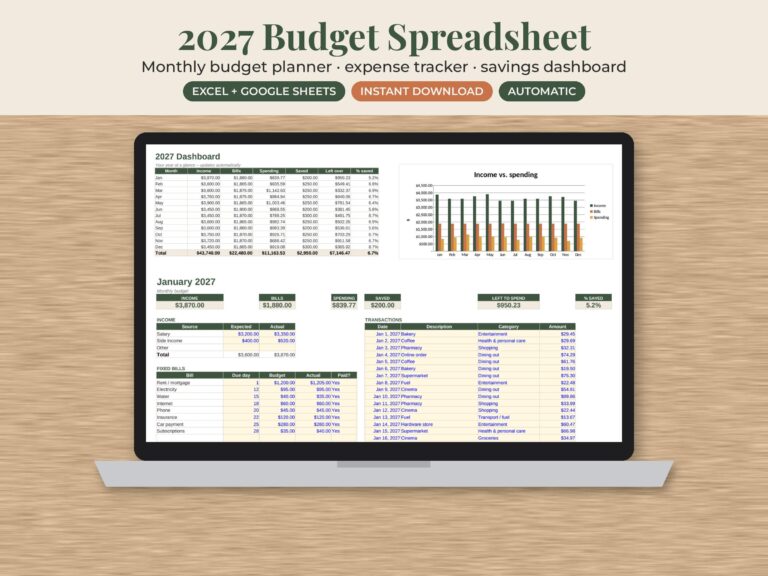
A good path for many people: start by budgeting per paycheck, then use extra checks to build a one-month buffer. Once that’s in place, switch to a monthly budget. The 2027 monthly budget spreadsheet suits that second stage.
What bills should come out of each paycheck?
Use these rules of thumb:
- Due before the next payday: pay from the current check.
- Housing: half from each check. Housing is the biggest line for most households. In the latest Bureau of Labor Statistics Consumer Expenditure Survey, housing averaged 33.4 percent of total spending in 2024.
- Yearly or irregular costs (car registration, annual subscriptions, school fees): a small sinking fund amount from every check.
- Savings: a fixed amount from every check, moved on payday, even if it’s $20.
- Variable bills like utilities: budget the higher winter or summer amount all year and keep any difference.
What do I do with the extra paycheck?
Because your budget runs on two checks, the third paycheck in a month is free of bills. Decide its job before it lands, or it tends to vanish into everyday spending.
A sensible order for most people:
- Starter emergency fund if you don’t have one. Even a few hundred dollars helps with a flat tire or a medical bill.
- High-interest debt. An extra $1,450 on a credit card can cut months off the payoff.
- Sinking funds for known costs later in the year: car repairs, back-to-school, insurance renewals.
- A one-month buffer in checking so you can move to budgeting by month.
- Long-term saving or a planned purchase.
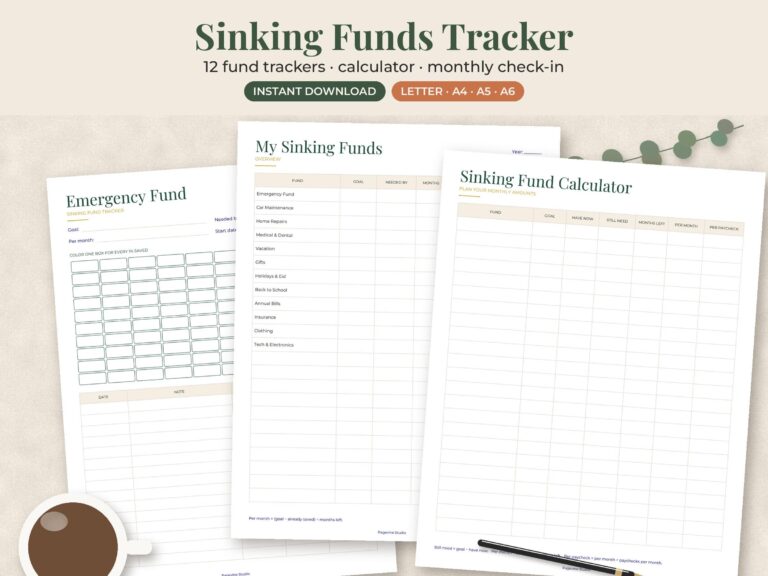
A sinking funds savings tracker makes it easy to split one extra check across several goals.
How to budget biweekly on a monthly calendar
A paper or digital calendar makes biweekly pay much easier to see.
- Mark every 2027 payday in one color.
- Mark every bill due date in another color.
- Draw a line from each bill back to the paycheck that will pay it.
- Circle the two three-paycheck months.
Ten minutes with a calendar shows you where the tight spots are before they happen.
Biweekly budgeting mistakes to skip
- Budgeting on gross pay. Always use take-home.
- Using the monthly average. It overestimates what you have in 10 months of the year.
- Forgetting annual bills. They’re why “good” budgets break in March or September.
- No payday check-in. Five minutes each payday to assign the money keeps the whole system working.
If you’d like a ready-made layout, our paycheck budget spreadsheet splits bills by payday and adds up what’s left on each check for you.
This is general information, not financial advice.