
Here is how to meal plan on a budget, in five moves: check what you already have, set a weekly grocery number, plan meals that share ingredients, shop from a list, and cook so that one meal makes two. That routine takes about 30 minutes a week once it becomes a habit.
This guide walks through each step with real numbers, including what USDA says a family of four needs to spend, a sample week of dinners, and tactics for a very tight budget or a household of two. It is general information, not financial advice, so adjust the figures to your own prices and needs.
How much should a family spend on groceries per month?
There is no single right number, but two official US figures give you a useful range.
- The USDA Thrifty Food Plan is the government’s estimate of the cost of a healthy, low-cost diet cooked at home. In its August 2026 Cost of Food report, USDA put that at $1,023.70 a month ($236.30 a week) for a family of four: two adults aged 20 to 50 and two children aged 6 to 8 and 9 to 11.
- What households actually spend. The Bureau of Labor Statistics Consumer Expenditure Survey found the average US household spent $6,224 on food at home in 2024, or about $519 a month. That is an average across all household sizes, including people living alone, and it does not include eating out.
USDA also publishes three higher plans: Low-Cost, Moderate-Cost, and Liberal. In the same August 2026 report, the monthly cost for one woman aged 20 to 50 in a four-person household was $275.70 on the Low-Cost plan, $336.10 on Moderate, and $428.80 on Liberal. Use the Thrifty figure as a “tight but healthy” target and the Moderate one as a comfortable ceiling.
Turn it into a weekly number
Weekly targets are easier to stick to than monthly ones. Take your monthly figure, multiply by 12, and divide by 52.
Example: if your family’s grocery budget is $900 a month, that is $900 × 12 ÷ 52 = about $208 a week. Every meal plan you write then has one job: fit inside $208.
If you live in the UK or Canada, the same method works with your own currency. Track two or three normal weeks of receipts first, then set your target a little below that.
How to meal plan on a budget in 7 steps
The steps below follow the same order USDA’s MyPlate team suggests in its guide to making a meal plan, with money-saving detail added at each stage.
1. Shop your kitchen first
Before you plan anything, look in the fridge, freezer, and cupboards. Write down anything that needs using up this week, like half a bag of spinach or a pack of chicken thighs in the freezer. Build at least two meals around those items. This one habit cuts waste more than any coupon.
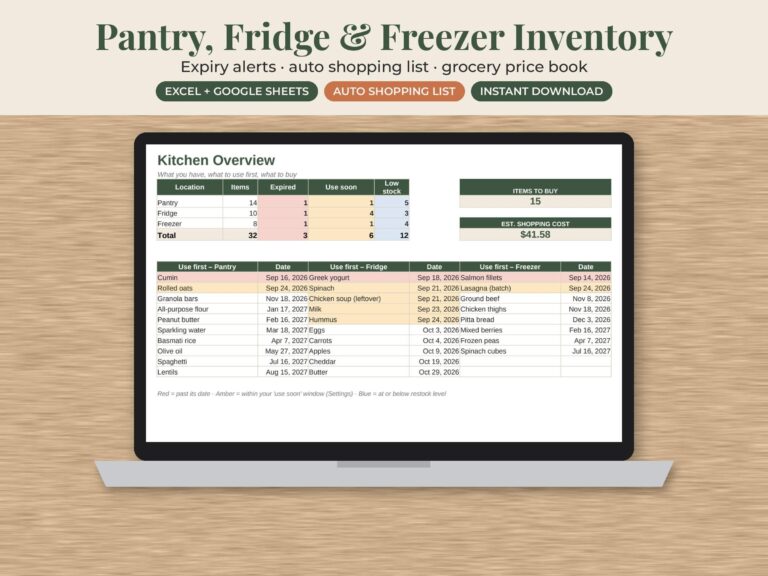
A simple pantry inventory list makes this a two-minute job instead of a ten-minute search.
2. Check your week’s schedule
Plan quick meals for busy nights and longer cooking for days off. If Tuesday has soccer practice until 7 pm, that is a leftovers night, not a lasagna night. A plan that ignores your real week falls apart by Wednesday, and then you buy takeout.
3. Choose 4 to 5 dinners, not 7
Plan four or five dinners and leave the other nights for leftovers or a simple “fridge clear-out” meal like omelets or fried rice. Planning every single night leads to food you never cook.
4. Make the meals share ingredients
This is where most of the savings come from. If you buy a bunch of cilantro for tacos, plan a rice bowl later in the week that uses the rest. One bag of onions, one big pack of chicken, one tub of yogurt: each should appear in two or three meals.
5. Write the grocery list by store section
Group the list into produce, dairy, meat, pantry, and frozen. You walk the store once, you do not double back past the snack aisle, and you are less likely to forget something and make an extra trip.
6. Mix fresh, frozen, and shelf-stable food
Fresh produce for the first half of the week, frozen and canned for the second half. Frozen vegetables do not wilt in the crisper drawer, so you pay only for what you eat.
7. Cook once, eat twice
Make a double batch of anything that reheats well: chili, soup, curry, pasta sauce. Eat half now and freeze half for a busy night later in the month.
A sample budget week for a family of four
Here is how ingredient sharing looks in practice. Notice how the same few items show up again and again.
| Day | Dinner | Uses up or sets up |
|---|---|---|
| Sunday | Roast whole chicken, potatoes, carrots | Save the leftover meat and the carcass for stock |
| Monday | Chicken and vegetable soup | Stock and meat from Sunday, plus onion and carrots |
| Tuesday | Leftover soup with toast (busy night) | No cooking needed |
| Wednesday | Bean and beef chili (double batch) | Canned beans and tomatoes; freeze half |
| Thursday | Baked potatoes topped with chili and yogurt | Rest of the potatoes and Wednesday’s chili |
| Friday | Egg fried rice with frozen peas | Rice, eggs, and any loose vegetables |
| Saturday | Lentil and vegetable curry with rice | Dry lentils, frozen spinach, onion |
That week runs on one chicken, one pound of ground beef, eggs, dry lentils, canned beans and tomatoes, potatoes, rice, onions, carrots, and two bags of frozen vegetables. It also leaves a portion of chili in the freezer for next week.
How to build your own week
- Pick one “big cook” meal that makes leftovers (a roast, a big pot of soup).
- Plan the next day’s meal to use those leftovers.
- Add one meatless dinner built on beans, lentils, or eggs.
- Add one pantry meal you can make from shelf-stable food.
- Leave one night for leftovers.
If you want a blank layout for this, our meal planner template page shows a few printable and digital options side by side.
How to meal plan on a tight budget
When money is very tight, these tactics make the biggest difference.
- Do one “pantry week” a month. Spend only on fresh basics like milk, eggs, and produce, and cook everything else from what you already own.
- Rotate a two-week menu. Fourteen dinners you know by heart means your list barely changes, and you get faster at shopping and cooking.
- Lean on low-cost proteins. Eggs, dry beans, lentils, canned fish, peanut butter, and chicken thighs are usually cheaper per serving than steaks or chicken breasts.
- Compare unit prices, not shelf prices. The small label on the shelf shows price per ounce, pound, or 100 g. The bigger pack is often cheaper per unit, but not always.
- Try store brands. For basics like oats, rice, canned tomatoes, and flour, the store brand is often the same quality for less.
- Plan breakfasts and lunches too. Oatmeal, eggs, and leftovers for lunch keep the “quick buy” costs down.
If you are in the US and money is very tight, food assistance programs exist for exactly this situation. Your local food bank can also point you to help in your area.
How to meal plan on a budget for 2
Cooking for two has its own problem: most recipes serve four, and many packs are sized for families. Here is how to make that work in your favor.
- Cook four portions and freeze two. You get a ready meal for a night when you do not feel like cooking.
- Plan “remix” meals. Taco filling on Monday becomes stuffed peppers on Wednesday.
- Buy fresh in small amounts, frozen in bigger ones. A large bag of frozen vegetables lasts for weeks. A large bag of fresh salad often does not.
- Split bulk packs right away. Divide a family pack of chicken into bags of two portions before it goes in the freezer.
As a rough guide, a couple usually spends a little more than half of what a family of four does. Smaller households pay more per person, and USDA adjusts its figures upward for them for that reason. Track your own receipts for a month to see your real number.
What is the cheapest way to plan healthy meals?
Cheap and healthy overlap more than people expect. The trick is knowing which budget foods still count.
The NHS guide to what counts toward your 5 A Day says frozen fruit and vegetables count, and so does canned produce, ideally packed in water or natural juice with no added sugar or salt. Beans and pulses like lentils and chickpeas count too, though only once a day however much you eat. One portion is 80 g.
So a healthy budget plate can look like this:
- Half the plate: frozen or canned vegetables, plus whatever fresh produce is cheapest that week
- A quarter: rice, potatoes, oats, or whole wheat pasta
- A quarter: eggs, beans, lentils, canned fish, or chicken
That pattern is close to the MyPlate model and works for most family meals without special ingredients.
Does meal planning really save money?
It does when you stick to the list. The savings come from three places:
- Less waste. You buy food for meals you have actually planned.
- Fewer takeout nights. When dinner is already decided, it is easier to skip the drive-through.
- Fewer extra trips. Each extra “just grabbing milk” trip tends to come home with more than milk.
Here is a simple way to see the effect. If unplanned buys and thrown-out food cost your family $25 a week, that adds up to $1,300 a year. Cutting that in half is $650 back in your pocket, without changing what you eat.
The honest catch: meal planning saves money only if you follow it. Start small. Plan three dinners for one week, then build from there.
Paper planner or meal planner spreadsheet?
Both work. The best one is the one you open every week.
| Printable weekly planner | Meal planner spreadsheet | |
|---|---|---|
| Best for | People who like to write and pin the plan on the fridge | People who want totals and reuse past weeks |
| Grocery list | Written by hand next to the plan | Can be built and sorted from your meals |
| Budget tracking | Write the receipt total at the bottom | Running totals by week and month |
| Family can see it | Yes, on the fridge | Shared on phones |
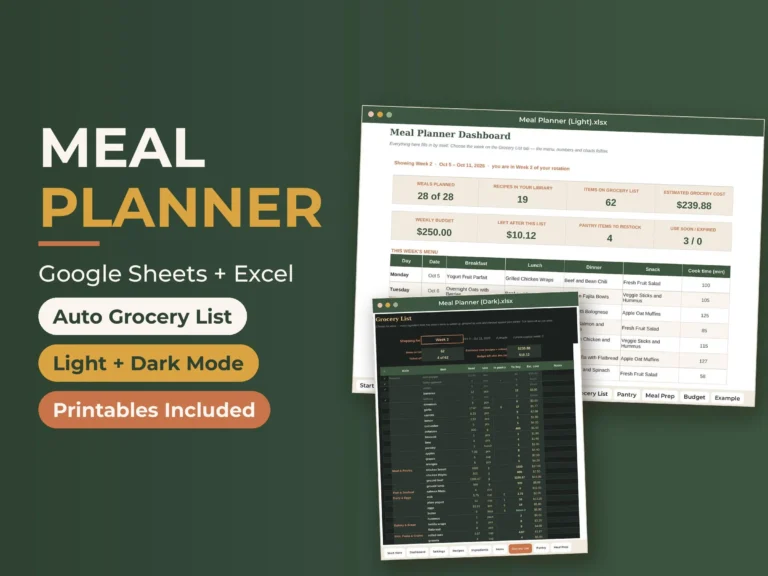
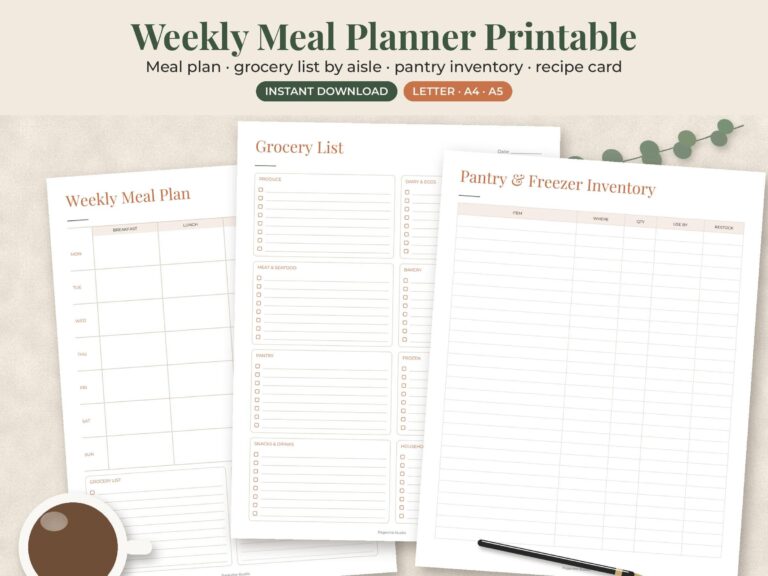
Our weekly meal planner and grocery list is the paper option, and the meal planner spreadsheet is the digital one. Many families pair either with a pantry inventory spreadsheet for step 1.
And if your best budget meals live on scraps of paper and in your head, collect them in one place. An editable family recipe binder turns your rotation of cheap, reliable dinners into something the whole family can cook from.