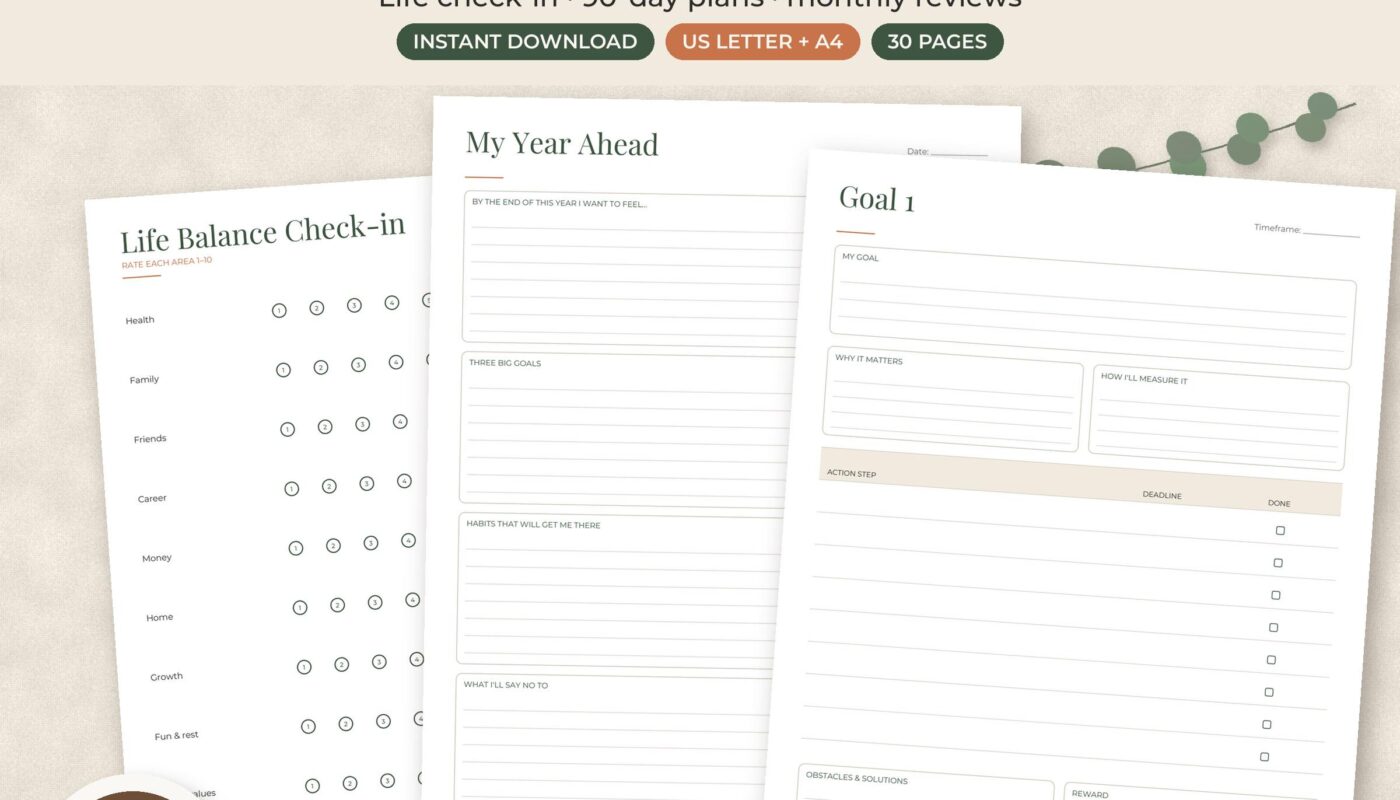
Here’s how to plan your year in one sitting: look back at 2026, choose the life areas that matter most, pick no more than three main goals, break each one into quarterly and monthly steps, then put real dates on a calendar. Finish by setting four review dates so the plan doesn’t get lost by March.
Block out one quiet afternoon in late December or the first weekend of January. January 1, 2027 is a Friday, which gives you a natural three-day weekend to do it. Below is the full process, with times for each step and a worked example.
Your 2027 planning guide at a glance
| Step | What you do | Time |
|---|---|---|
| 1. Look back | Review what worked and what didn’t in 2026 | 30 minutes |
| 2. Choose life areas | Pick 3 to 5 areas to focus on | 15 minutes |
| 3. Set goals | Write 1 to 3 main goals, each with a finish line | 30 minutes |
| 4. Break them down | Turn each goal into quarterly and monthly steps | 45 minutes |
| 5. Put it on the calendar | Add deadlines, review dates and known busy weeks | 20 minutes |
| 6. Pick a word (optional) | Choose a word of the year to guide small decisions | 10 minutes |
Total: about two and a half hours. Bring a pen, a printed 2027 calendar and a drink.
Step 1: Look back before you plan ahead
Planning a new year without reviewing the old one means repeating the same mistakes. Spend 30 minutes with your 2026 calendar, photos and bank statements, and answer these five questions on paper:
- What am I proud of from this year?
- What took more time or money than I expected?
- What did I start and drop? Why?
- When did I feel most like myself?
- What do I want less of in 2027?
Question 3 is the useful one. If you dropped a gym plan in February again, the problem wasn’t willpower. It was probably the plan.
Step 2: New year goals categories to choose from
Life areas stop one part of your life (usually work) from taking over the whole plan. You don’t need goals in every area. Choose 3 to 5 that need attention this year.
| Life area | Example 2027 goal |
|---|---|
| Health | Walk 30 minutes, 5 days a week |
| Money | Save a $3,000 emergency cushion |
| Work and career | Finish one certification course by September |
| Learning | Read 12 books, one per month |
| Family and friends | One planned outing with each child per month |
| Home | Declutter one room per month |
| Fun and creativity | Finish one craft or photo project per quarter |
| Rest | Take every day of paid leave you’re given |
| Community | Volunteer once a month |
Need more new year goals ideas? Look at your answers from Step 1. The thing you want less of usually points straight at the area to work on.
Step 3: How many goals should you set for a year?
We’d say three main goals, five at most. Every goal needs time, money or energy each week. Ten goals means ten things competing for the same Saturday.
Make each goal clear enough that a stranger could tell whether you hit it:
- Vague: “Get healthier.” Clear: “Walk 30 minutes, 5 days a week, through December.”
- Vague: “Save more.” Clear: “Save $3,000 by December 31.”
- Vague: “Read more.” Clear: “Read 12 books in 2027.”
Write each one as a single sentence with a number and a date. Keep any extra “nice to have” ideas on a separate list. If you finish a main goal early, pull one in.
Step 4: How do you break yearly goals into monthly steps?
A year is too long to feel urgent. A month is not. Divide each goal into four quarters, then into monthly targets, then decide what you’ll do each week.
Worked example: save $3,000 in 2027
- Yearly: $3,000 by December 31.
- Quarterly: $750 by the end of March, June, September and December.
- Monthly: $250.
- Weekly action: Automatic transfer of $125 on each payday, if you’re paid twice a month. (Paid every two weeks? $115 per paycheck gets you to $2,990 over 26 paychecks. Add a few dollars to round up.)
Worked example: read 12 books
- Monthly: One book.
- Weekly action: About 75 pages a week for a 300-page book, or roughly 20 minutes a night.
- Setup: Pick your first three books before January 1 so you’re never deciding what to read next.
The weekly action is what you’ll actually do. If you can’t name one for a goal, it isn’t ready yet.
Turn some goals into habits
Goals like “walk 5 days a week” are really habits. Habits take longer to stick than most people expect. In a UCL study on habit formation, it took an average of 66 days for a new daily behavior to become automatic. The published paper’s abstract reports a range of 18 to 254 days across participants.
The same research found something encouraging: missing one day didn’t materially affect the habit. Inconsistency did. So plan for about two to three months of effort per new habit, and don’t quit after one missed day. A 2027 monthly habit tracker makes those streaks easy to see.
That 66-day figure is also a good reason not to start four new habits on January 1. Start one. Add the next in March.
Step 5: Put the plan on a real calendar
A plan that only lives in a notebook gets forgotten. Take a printed 2027 calendar and mark:
- Goal deadlines, including quarterly targets.
- Review dates. 2027’s quarters end on Wednesday, March 31; Wednesday, June 30; Thursday, September 30; and Friday, December 31. Schedule a one-hour review on the weekend after each.
- Known busy weeks such as tax season, school breaks, work deadlines and family events. Don’t plan a big goal push for those.
- Long weekends. In the US, the OPM 2027 federal holiday list includes Memorial Day (May 31) and Labor Day (September 6). Long weekends make good checkpoints and good rest. UK readers can use our 2027 UK calendar with bank holidays, and Canadian readers our 2027 Canada calendar.
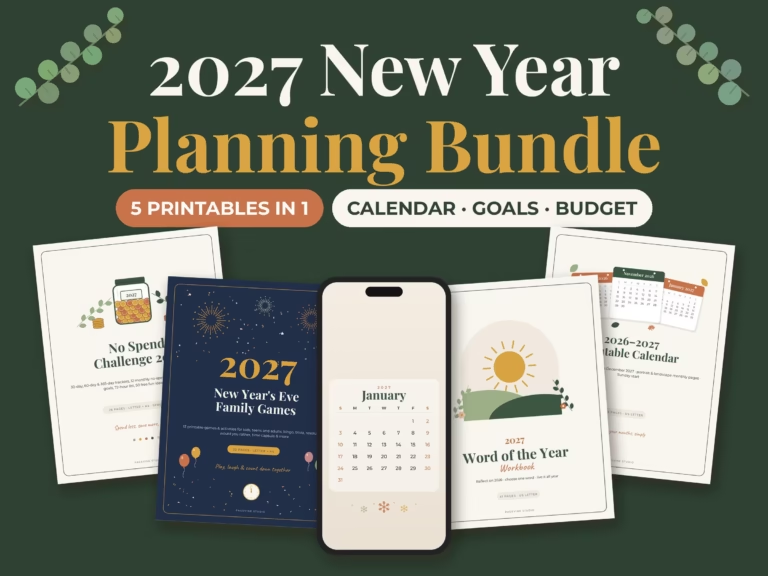
A wall calendar keeps your goals in front of the whole household. A 2027 planner bundle puts a 15-month calendar, a word of the year workbook with monthly check-ins and quarterly reviews, and phone lock-screen calendars in one set.
Step 6: What is a word of the year?
A word of the year is one word you pick to guide your choices for the next 12 months. Instead of a goal you hit or miss, it’s a filter. When you’re deciding whether to say yes to something, you ask: does this fit my word?
It works well alongside goals. If your word is “simplify,” you’ll notice when a new commitment adds clutter. If it’s “finish,” you’ll pick up the half-done projects before starting new ones.
Word of the year 2027 ideas
Steady, focus, simplify, build, rest, brave, finish, grow, enough, connect, create, consistent, patient, present, learn, strong, clear, kind, save, home.
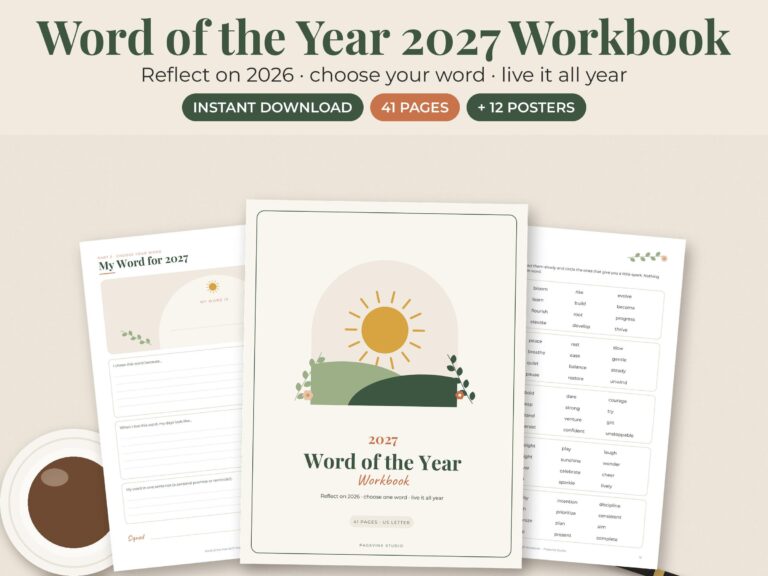
To choose, read your Step 1 answers again and circle any word that keeps coming up. Then write it somewhere you’ll see daily. A word of the year 2027 workbook walks you through reflection, choosing the word and setting intentions, with posters to print.
Quarterly review: five questions to keep the plan alive
Most yearly plans fail quietly. Nobody decides to quit. The plan just stops being checked. A one-hour review every three months fixes that.
- Which goals are on track? Which aren’t?
- For each goal that’s behind, is the problem time, money, energy or interest?
- Does this goal still matter? (It’s fine to drop one. Write down why.)
- What’s the single most important thing for the next 90 days?
- What’s coming up next quarter that I need to plan around?
Keep the answers in the same notebook or workbook as your original plan, so you can see the whole year’s story in December.
Annual planning for personal life: common mistakes
- Planning only for January. Write steps for all four quarters now, even if they’re rough.
- No slack. Leave at least one month of the year with no new targets. Something will come up.
- Copying someone else’s goals. A goal you don’t care about won’t survive March.
- All outcome, no action. “Lose weight” is an outcome. “Cook dinner at home five nights a week” is an action you control.
- Skipping rest. Put time off on the calendar first, then fit goals around it.
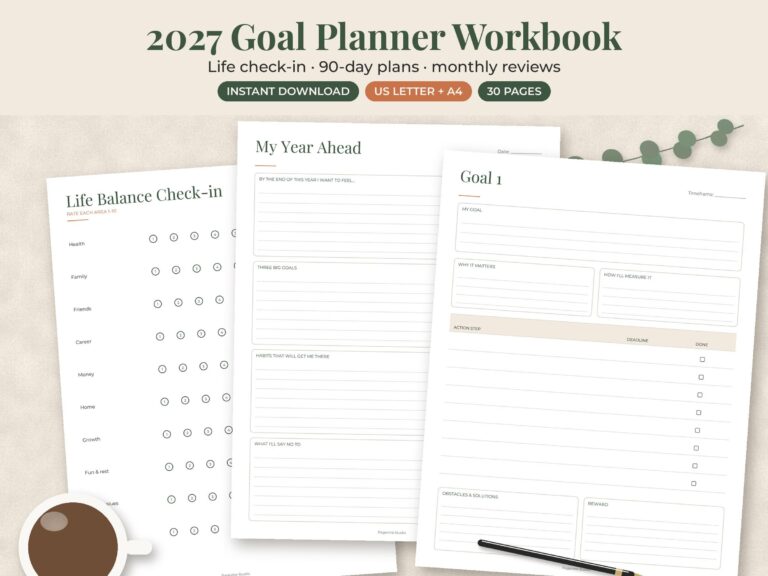
If you want a ready-made version, the 2027 goal setting workbook includes growth planner pages and action plan worksheets for this exact process, and the 2027 calendars and planners collection has calendars to pair with it.