
The easiest Thanksgiving activities for kids at the table are the ones already sitting at their seat when they arrive: an activity placemat, a few crayons, a cup of paper leaves to write on, and one conversation game an adult can start. Add a craft for toddlers and a coloring stack for after dinner, and most kids will happily stay put without a tablet.
Here’s what to set out by age, what to do at each stage of the meal, and how to make a kids table the place children actually want to sit.
What can kids do at the Thanksgiving table? A by-age guide
| Age | Attention span at the table | Best activities |
|---|---|---|
| 2 to 3 | Short. Plan to swap activities often. | Big crayons, stickers on paper, sticker turkey, finger puppets |
| 4 to 5 | A bit longer | Simple coloring pages, dot markers, I Spy, easy mazes |
| 6 to 8 | Can finish a full activity sheet | Activity placemats, word searches, thankful leaves, would-you-rather cards |
| 9 to 12 | Long enough for a game or project | Trivia, story chains, harder puzzles, running a game for little ones |
For a mixed table, set activities by seat, not by table. A 3-year-old next to a 10-year-old should each have their own thing in front of them.
Why skip the screens at the table
The American Academy of Pediatrics’ parenting site puts it simply in Food and Media: Not a Healthy Mix: make meals media-free, put devices aside, and focus on food and each other. It also notes that kids distracted by a screen often eat well past the point of being full.
On Thanksgiving, there’s a bonus. Kids who look up from a screen are kids who talk to grandparents. That’s the whole point of the day.
Screens aren’t banned forever. Many families allow a short movie on the couch after dinner. The table is just the screen-free zone.
Build a kids table kit the night before
Fifteen minutes on Wednesday night saves you an hour of “I’m bored” on Thursday. Put everything in a shoebox or basket for each end of the table.
- One activity placemat per child, plus two spares
- Crayons in a cup (break wrappers off for toddlers so they can use the sides)
- A stack of coloring pages sorted from simple to detailed
- Paper leaves cut from orange and brown paper, and a few pencils
- A small jar of conversation cards
- Washable markers only, never permanent ones near a tablecloth
- A roll of masking tape and a few stickers for the youngest
- Wet wipes
Cover the kids table with kraft paper or a paper tablecloth. Kids can draw directly on it, and cleanup is one roll into the recycling.

Before the food arrives (the first 15 minutes)
This is the hardest stretch. Kids are hungry, the adults are busy, and the turkey is being carved. Have the placemats down before anyone sits.
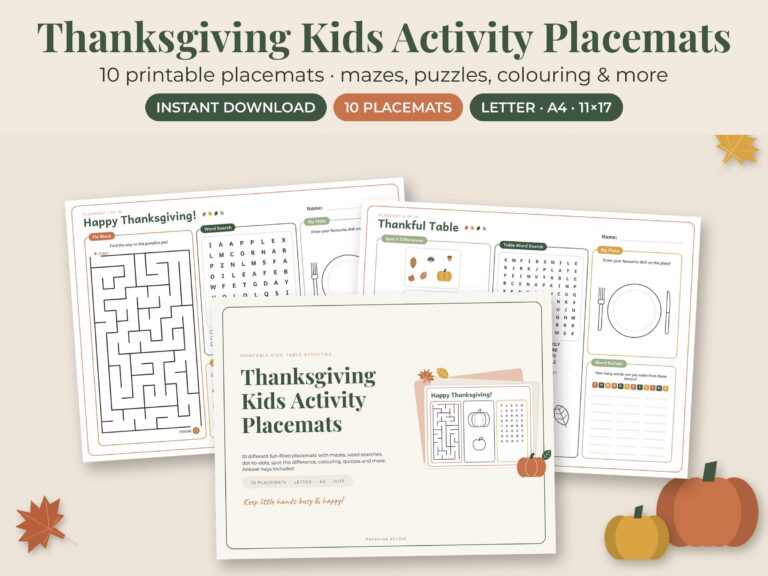
- Activity placemats. A Thanksgiving kids activity placemat with coloring, mazes and a word search keeps 6 to 8 year olds busy until plates arrive. Print on 11×17 paper if you can, so it covers their whole spot.
- Make your own place cards. Give each child a folded card and ask them to decorate one for a grown-up. They’ll be proud when Grandpa finds his name.
- Table I Spy. “I spy something orange.” It works for ages 3 and up and needs nothing.
- Thankful leaves. Each child writes or draws one thing they’re thankful for on a paper leaf. Younger kids can dictate to an older cousin. Tape the leaves to a wall or window later.
During the meal: conversation games that keep kids seated
Once food is on the plates, crayons go down and talk takes over. These games need no supplies.
Best part, hard part
Each person shares the best part of their year and one hard part. Kids often say surprising things, and grandparents love hearing them.
Story chain
One person starts a story with one sentence: “A turkey walked into a library…” Everyone adds a sentence around the table. Kids ages 6 to 12 love the silly turns.
Would you rather
“Would you rather have a pet turkey or a pet pumpkin that talks?” Let kids ask the adults too. They’ll enjoy seeing grown-ups squirm.
Thankful A to Z
Go around the alphabet, naming something you’re grateful for. Older kids can help younger ones with tough letters.
After dinner: Thanksgiving activities for kids at home
Adults usually want another half hour at the table. Give the kids a “second shift” of activities somewhere nearby.
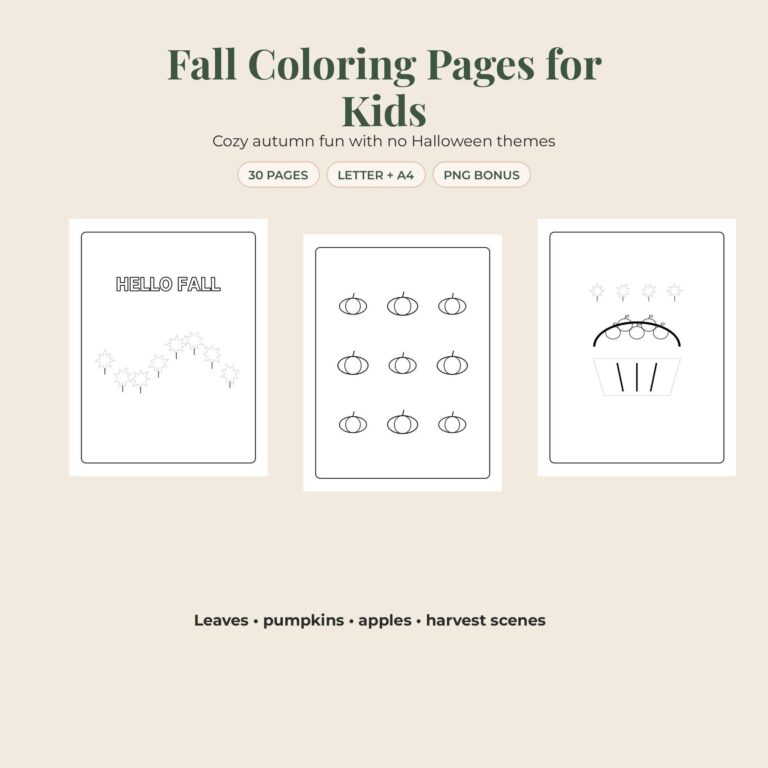
- Coloring station. Set up a corner with Thanksgiving coloring pages for kids covering pumpkins, apples, leaves and harvest scenes. Our printable coloring pages page has more themes for younger children.
- Indoor scavenger hunt. Hide paper turkeys around one or two rooms. Pair big kids with little ones.
- Kids’ show. Older children write and act out a five-minute skit about the meal. They perform it for the adults at dessert.
- Thankful tree. Draw a bare tree on a large sheet of paper. Kids tape their thankful leaves to it. Keep it up through the weekend.
- Outdoor run. Ten minutes of tag or a backyard race helps after a heavy meal, and everyone sleeps better.
Easy Thanksgiving crafts for toddlers
Keep toddler crafts short (5 to 10 minutes), mess-light, and about the process, not the result. Keep small items like dried corn, beads and googly eyes away from children under 3, since they can be a choking hazard.
- Handprint turkey. Trace the child’s hand on paper. The thumb is the head, the fingers are feathers. They color each feather with a different crayon.
- Paper plate turkey. Glue precut paper feathers around the edge of a paper plate. Use a glue stick, not liquid glue.
- Sticker harvest scene. Draw a simple fence and ground line on paper. Toddlers add leaf and pumpkin stickers. It’s great for fine motor skills.
- Leaf rubbings. Put a real leaf under paper. Toddlers rub a crayon (wrapper off, on its side) over it to reveal the leaf.
Our tip: do the craft before the meal, not after. Tired toddlers and glue don’t mix well.
Good Thanksgiving activities for kids at school
Teachers and homeschool parents often want something with a learning goal attached. These work well in November.
- Thanksgiving reading comprehension. Short fall-themed passages with questions build reading skills without feeling like extra homework. These Thanksgiving reading comprehension passages are written for grades 1 to 3.
- History with real sources. The Library of Congress Thanksgiving classroom materials include primary sources on the 1621 harvest celebration and on Sarah Josepha Hale, the magazine editor whose 1863 letter helped persuade Abraham Lincoln to proclaim a national day of thanksgiving. Older kids can read one source and write three facts.
- Recipe math. Give students a simple recipe and ask them to double it or cut it in half. It’s real fractions practice.
- Gratitude writing. Students write a short note to a school worker they don’t usually thank: the custodian, the bus driver, the lunch staff.
A Thanksgiving kids activity bundle pulls several of these together for a classroom: placemats with answer keys, word searches, a thankful tree project, reading passages and coloring pages.
How do I make a kids table fun?
The kids table gets a bad name when it feels like exile. A few changes flip that.
- Give it a captain. Ask the oldest child (10 to 13 works well) to run the table: pass the rolls, start the games, help little ones.
- Make it look special. A paper tablecloth to draw on, their own name cards, and a small centerpiece they made.
- Kid-sized dishes. Put small bowls of the foods kids actually eat on their table, so they don’t wait for the grown-up platters.
- Seat it close. Put the kids table near the main table, not in another room. Kids behave better when they can see adults, and they feel included.
- Visit them. Each adult stops by once during the meal to ask a question or play one round of a game.
- Let them graduate. Tell older kids that next year they can choose to stay or move up. Many choose to stay.