
If you’re wondering how to make a budget for beginners, it comes down to four moves: write down your monthly take-home pay, list every bill and expense, subtract one from the other, and give every leftover dollar a job. That’s it. The rest of this guide shows you how to do it with real numbers, which categories to use, and how to keep it going past January 2027.
This is general information, not financial advice. Your situation may need a different plan.
A worked example: $3,600 a month, start to finish
Let’s say your take-home pay (after tax and payroll deductions) is $3,600 a month. Here’s a first budget built from scratch. Every dollar is assigned, so the total spent plus saved equals the total earned.
| Category | Monthly amount | Type |
|---|---|---|
| Rent | $1,250 | Need |
| Utilities (power, water, gas) | $180 | Need |
| Phone and internet | $110 | Need |
| Groceries | $520 | Need |
| Car payment | $280 | Need |
| Gas for the car | $140 | Need |
| Car insurance | $130 | Need |
| Health costs (copays, prescriptions) | $60 | Need |
| Minimum debt payments | $100 | Need |
| Subscriptions | $40 | Want |
| Eating out and takeout | $180 | Want |
| Personal (haircuts, clothes, toiletries) | $150 | Want |
| Fun money | $120 | Want |
| Yearly costs set aside (gifts, car registration) | $100 | Want |
| Savings | $240 | Savings |
| Total | $3,600 |
Look at the split. Needs add up to $2,770, about 77% of take-home pay. Wants are $590 (16%) and savings are $240 (7%). That’s common for a first budget, especially if rent is high. Don’t panic. The point of the first month is to see the truth, not to hit a perfect ratio.
Now make two small moves. Cut eating out from $180 to $100 and fun money from $120 to $80. That’s $120 more for savings, which brings it to $360 a month, or 10%. Over a year, that’s $4,320 set aside instead of $2,880.
How to make a budget for beginners: 6 steps
The US government’s consumer.gov guide to making a budget uses the same core method: gather your bills and pay stubs, list expenses, work out income, then subtract. We’ve added two steps that help it stick.
- Gather your paperwork. Pull your last two pay stubs, last month’s bank and card statements, and any bills that don’t come monthly (insurance, car registration, subscriptions billed yearly).
- Find your monthly income. Use take-home pay, not salary. If you’re paid every two weeks, multiply one paycheck by 26 and divide by 12. If your income changes month to month, consumer.gov suggests adding up last year’s income and dividing by 12.
- List every expense. Start with fixed bills (rent, car payment), then add the ones that change (groceries, gas). Go through your statements line by line. Many people find a charge or two they’d forgotten about.
- Subtract. Income minus expenses. As consumer.gov puts it, the number should be more than zero. If it’s below zero, you’re spending more than you make, and you’ll need to find items to change.
- Give every leftover dollar a job. Savings, extra debt payments, or money set aside for a known future cost. Unassigned money tends to vanish.
- Track and review monthly. Write down what you spend as you go. At the end of the month, compare plan to reality and adjust the next month.
Monthly budget categories list
Use as few categories as you can while still seeing where money goes. Ten to fifteen is plenty for a beginner. The FTC’s free budget worksheet groups expenses into housing, food, transportation, health, personal and family, school, and other. That’s a good base. Here’s a fuller list:
- Housing: rent or mortgage, renters or home insurance, property tax, utilities
- Food: groceries, eating out (keep these separate)
- Transportation: car payment, gas, insurance, repairs, transit passes
- Health: insurance premiums not taken from your pay, copays, prescriptions
- Debt: minimum payments on cards, student loans and other loans
- Personal and family: childcare, clothes, haircuts, school costs
- Bills: phone, internet, subscriptions
- Fun: hobbies, outings, takeout treats
- Yearly costs: birthday gifts, car registration, annual memberships, back-to-school
- Savings: emergency fund, short-term goals, retirement (if not taken from your pay)
Want to see how your spending compares? In the Bureau of Labor Statistics 2024 Consumer Expenditure Survey, US households spent an average of 33.4% of their total spending on housing, 17.0% on transportation, 12.9% on food and 7.9% on healthcare. Those are averages across all households, not targets, but they show why housing and transport usually dominate a budget.
What is the 50/30/20 rule?
It’s a simple rule of thumb popularized by Elizabeth Warren and Amelia Warren Tyagi in their book All Your Worth. Split take-home pay three ways:
- 50% needs: housing, utilities, groceries, transport, insurance, minimum debt payments
- 30% wants: eating out, hobbies, subscriptions, upgrades
- 20% savings and extra debt payments
On $3,600 a month, that’s $1,800 for needs, $1,080 for wants and $720 for savings.
It’s a useful check, not a law. In our example, needs came to 77%, which is common in high-rent cities. If that’s you, don’t force 50/30/20. Treat it as a direction: try to move a few percent from wants to savings each year as your income grows.
Zero-based budget for beginners
A zero-based budget means income minus every planned dollar equals exactly zero. The example table above is a zero-based budget: $3,600 in, $3,600 assigned. Zero doesn’t mean you spend everything. Savings counts as a job.
| 50/30/20 | Zero-based | |
|---|---|---|
| Effort | Low. Three buckets. | Higher. Every category planned. |
| Best for | Steady income, people who hate detail | Tight months, paying off debt, irregular costs |
| Weak spot | Hard to follow when needs are over 50% | Needs a monthly check-in |
Our take: start zero-based for the first three months so you learn your real numbers. Then switch to 50/30/20 as a quick monthly check if the detail wears you out.
Is a budget spreadsheet better than an app?
Neither is better for everyone. It depends on how you like to work.
- Choose a spreadsheet if you want full control, no monthly fee, and no need to link your bank account. You see every formula and can change any category. A budget spreadsheet for beginners should do the math for you, so you only type numbers.
- Choose an app if you want transactions pulled in automatically and you’re comfortable linking accounts. Many apps charge a monthly fee for the useful features.
- Choose paper if writing things down helps you remember them. It works, but you’ll do the math yourself.
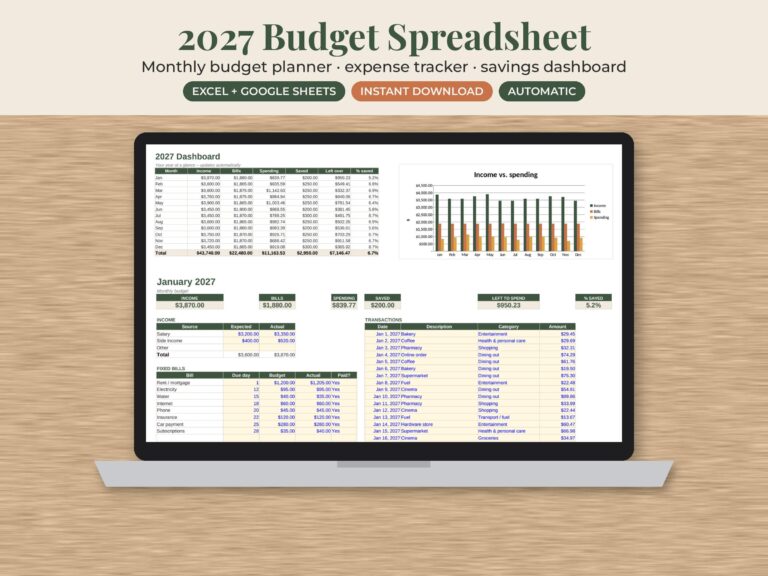
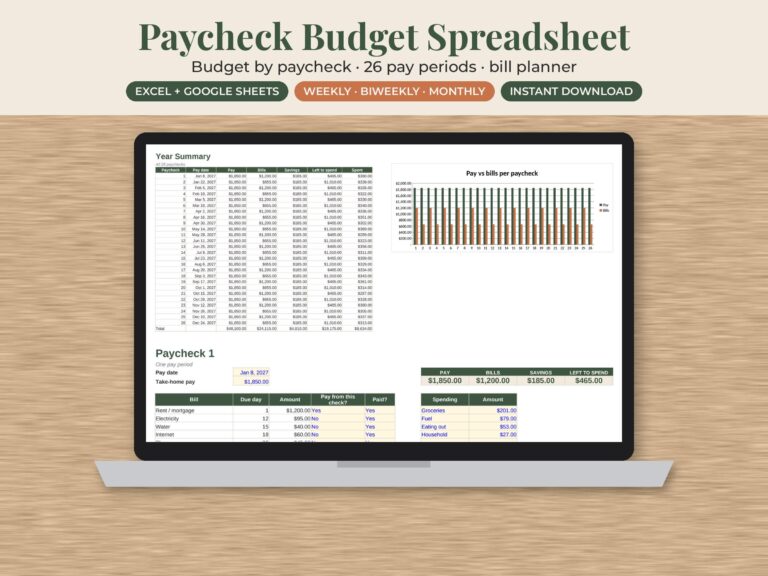
A budget spreadsheet in Google Sheets is a good middle ground. It’s free, it works on your phone, and you can share it with a partner. A 2027 monthly budget spreadsheet combines a monthly budget planner, an expense tracker and a savings tracker, and works in Google Sheets or Excel. If you’re paid every two weeks, a paycheck budget spreadsheet plans each paycheck separately, which can be easier.
How much should I save each month?
The 50/30/20 rule says 20% of take-home pay, but that’s a stretch for many first budgets. The Consumer Financial Protection Bureau’s emergency fund guide says the right amount depends on your situation, and that even a small amount provides some security.
A practical path:
- Start with any fixed amount you can keep up, even $25 a paycheck.
- Make it automatic. The CFPB calls saving automatically one of the easiest ways to stay consistent. Set a recurring transfer for payday, or split your direct deposit if your employer allows it.
- Build a small cushion first, then raise the amount each time you get a raise or pay off a debt.
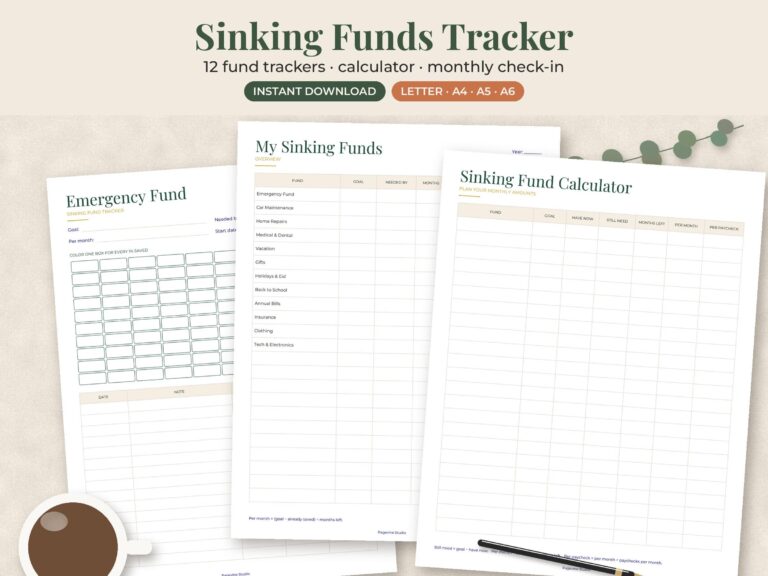
- Save separately for known costs. Car repairs, gifts and yearly bills aren’t emergencies. Put money aside for them monthly in a “sinking fund” so they don’t wreck a month. A sinking funds savings tracker keeps each pot visible.
New year budget plan: how to stick to it in 2027
January is the easy part. The real test is March, once the fresh-start feeling fades. These habits help.
- Set it up in late December. January 1, 2027 is a Friday. Sit down the week before with your statements so you start the year with a plan, not a guess.
- Map 2027’s big one-off costs now. Go month by month and note car registration, insurance renewals, back-to-school, Thanksgiving travel and birthdays. Divide the total by 12 and add it to your yearly costs line.
- Do a 15-minute money date each week. Same day, same time. Check spending against the plan.
- Expect to overspend in month one. Your first budget is a guess. Adjust category amounts after the first month, not after the first bad day.
- Keep a small buffer. A $50 “oops” line stops one surprise from breaking the whole plan.
- Tackle debt with a plan. If debt payments are eating your budget, a debt payoff tracker helps you pick an order and see progress.
Outside the US? The steps are the same. In the UK, add council tax under housing. In Canada, plan for your TFSA or RRSP contributions under savings.
If you want a ready-made layout, the budget templates and spreadsheets collection has monthly, paycheck and savings trackers you can start with in January.