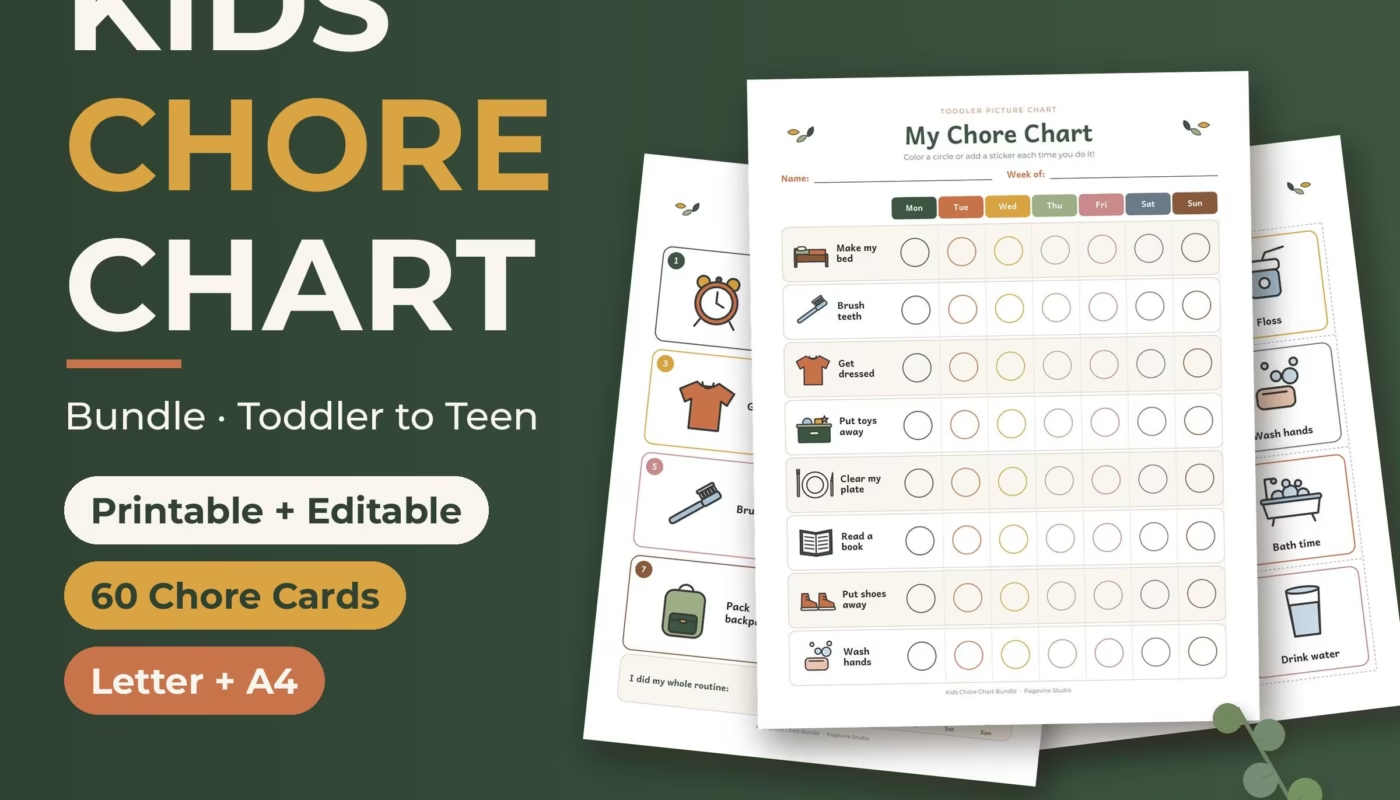
A morning routine chart for kids is a short list of steps, shown in order, that your child follows from waking up to walking out the door. Toddlers need 3 or 4 picture steps. Preschoolers can handle 5 or 6. School-age kids can follow 6 to 8 steps on a word checklist. Put it at your child’s eye level, walk through it together for the first week, and add a sticker for each finished morning.
Below you’ll find sample routines for each age, how to choose a picture or word chart, 12 tips that make the chart actually stick, and reward ideas that don’t involve sweets.
Morning routine chart quick picks by age
| Age | Number of steps | Chart type | Adult role | Reward style |
|---|---|---|---|---|
| Toddler (2 to 3) | 3 to 4 | Large pictures only | Does each step alongside | Praise, a sticker right away |
| Preschool (3 to 5) | 5 to 6 | Pictures with one-word labels | Prompts and checks | Sticker chart, small reward after 5 stickers |
| School-age (6 to 9) | 6 to 8 | Words with small icons | Points to the chart, then steps back | Weekly reward chart |
| Tweens (10 to 12) | 6 to 8 | Plain checklist | Checks in at the end | Privileges, not stickers |
Morning routines by age (copy these)
These are starting points, not rules. Write down the order your morning already runs, then trim it to fit your child.
Toddler morning routine (ages 2 to 3)
- Potty or diaper change
- Get dressed (you help)
- Eat breakfast
- Brush teeth
At this age, the chart is really for you both. You point at the picture, say the step out loud, and do it together. The CDC’s guide to routines for toddlers and preschoolers reminds parents to “consider your child’s capabilities and understanding,” so keep each step tiny. “Get dressed” might just mean pulling on socks while you do the rest.
Preschool morning routine (ages 3 to 5)
- Use the toilet and wash hands
- Get dressed (clothes laid out the night before)
- Eat breakfast
- Put cup or bowl by the sink
- Brush teeth
- Shoes on, backpack by the door
Preschoolers love to “read” a picture chart by themselves. Expect the whole routine to take 30 to 40 minutes, with you nearby to prompt. Shoes are usually the slow step, so put them last and leave extra time.
School-age morning routine (ages 6 to 9)
- Get up with the alarm or wake-up light
- Use the bathroom, wash face
- Get dressed
- Make bed (pulling the cover up counts)
- Eat breakfast and clear your plate
- Brush teeth and hair
- Check backpack: homework, lunch, water bottle
- Shoes and coat on
Now the chart does the reminding, not you. If your child can follow these steps on a school day, try handing over one more job, like packing a simple lunch. Our list of age-appropriate chores for kids has ideas for each age.
Tween morning checklist (ages 10 to 12)
Tweens rarely want a “kids” chart. Give them a plain checklist on the bathroom mirror or inside a closet door, and let them set their own alarm. Your job is to check in once at the end, not to manage each step.

Picture chart or word chart?
The right choice depends on whether your child can read the steps alone, not on age.
| Picture chart (kids visual schedule) | Word chart | |
|---|---|---|
| Best for | Toddlers, preschoolers, early readers, kids who do better with visuals | Confident readers, usually age 6 and up |
| How it looks | One picture card per step, often movable | A list with checkboxes or a column for each day |
| Main benefit | Child can follow it with no reading | Fits more steps, feels more grown up |
| Watch out for | Too many cards on one strip | Steps written as vague goals (“be ready”) |
A good middle step for 5- and 6-year-olds is a picture with one word underneath. Kids start reading the word because they already know the picture.
How to make a morning routine chart in 20 minutes
Supplies: a printed chart or picture cards, a laminator or clear packing tape, hook-and-loop dots or a dry-erase marker, and stickers.
- Write your routine on scrap paper and cut it to the step count for your child’s age.
- Print one picture or line per step. Cards should be at least the size of a playing card for toddlers.
- Laminate or tape over the chart so it survives wet hands and spilled cereal.
- Add a “done” pocket or a second strip of hook-and-loop dots so your child can move each card when the step is finished.
- Hang it where the routine happens, at your child’s eye level.
12 tips that make a morning routine chart stick
1. Start with the morning you already have
Don’t invent a perfect routine. Follow your family for two mornings and write down what actually happens, in that order. A chart that matches real life is easier to follow than one that fights it.
2. Keep one action per step
“Get ready” is not a step. “Put on socks” is. If a step needs two pictures to explain, split it in two, and cut a less important step to keep the total short.
3. Do half the work the night before
The American Academy of Pediatrics’ advice on family routines says, “To help mornings go more smoothly, put as many things in order as possible the night before.” Lay out clothes, pack the backpack and put shoes by the door. A five-minute evening chart can make the morning chart much shorter.
4. Hang it where the step happens
One chart by the bedroom door works for most families. If your child spends the morning moving between rooms, try two small charts: one in the bedroom, one in the bathroom.
5. Practice on a weekend
Run through the chart on a Saturday, when nobody is rushing. Make it a game. Your child learns the steps without the pressure of a school bus.
6. Do it together for the first week
Expect to walk through every step alongside your child for five to seven mornings. Then stand back a little more each day. Most kids need two to three weeks before the routine feels automatic.
7. Point to the chart instead of giving orders
Swap “Go brush your teeth” for “What’s next on your chart?” The chart becomes the boss, which means fewer arguments with you.
8. Offer small choices
The AAP suggests you “Help avoid last-minute squabbles by offering kids a choice when possible.” Red shirt or blue? Cereal or toast? Small choices give kids control without changing the routine.
9. Praise the exact step
“You put your bowl by the sink without being asked” teaches more than “Good job.” The CDC puts it simply: to increase good behaviors, “praise them each time you see them occur.”
10. Time the slow step
Every child has one step that drags. Use a sand timer or a visual timer for that step only, like five minutes for getting dressed. Kids can see time running out without you counting down.
11. Build in a buffer
Plan the routine to finish 10 minutes before you actually need to leave. If your child finishes early, the leftover time is theirs for drawing, a puzzle or a picture book. That gives them a real reason to keep moving.
12. Review it after two weeks
The AAP notes that “it helps to review the routines in your household to ensure that they accomplish what you want.” Drop steps your child now does without thinking, and add a new one if they are ready. Charts should grow with your child.
Sticker chart and reward chart ideas
A sticker chart works best when the goal is clear and the reward comes quickly. For preschoolers, one sticker per finished morning and a small reward after five stickers is about right. School-age kids can wait for a weekly reward.
Low-cost reward ideas that aren’t sweets or toys:
- Choose the Saturday breakfast
- An extra bedtime story
- Pick the park or the walk route
- Ten extra minutes of a favorite game
- Help cook dinner one night
- Stay up 15 minutes later on Friday
- A “skip one chore” card
- Choose the family board game
Keep the reward chart separate from the routine chart if you can. The routine chart shows what to do. The reward chart shows progress. Mixing both on one page gets cluttered fast.
Once the routine runs smoothly for two or three weeks, phase the stickers out slowly. Give them every other day, then only on Fridays. The praise stays.
When the morning chart stops working
- Your child ignores it: it may be too long. Cut it to four steps and rebuild from there.
- Mornings are still rushed: move more steps to the night before, or wake everyone 10 minutes earlier.
- Arguments over stickers: reward the whole morning, not each step.
- Siblings compete: give each child their own chart in a different color.
Ready-made routine charts
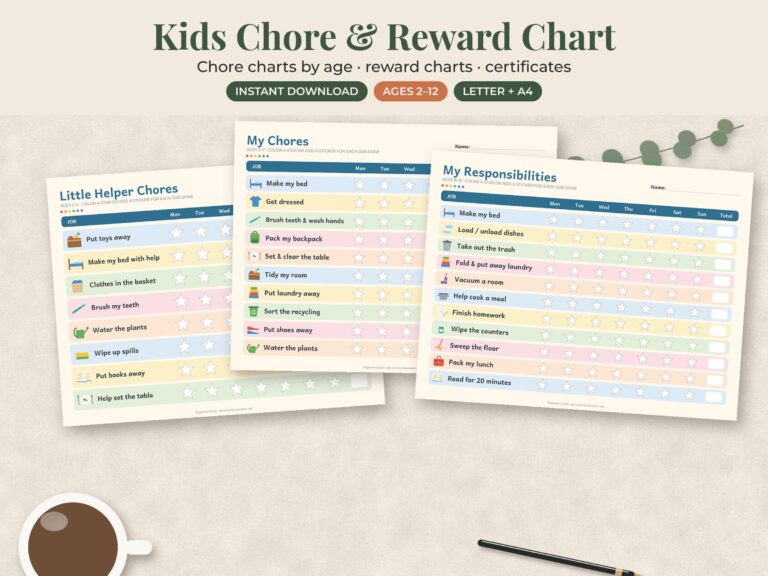
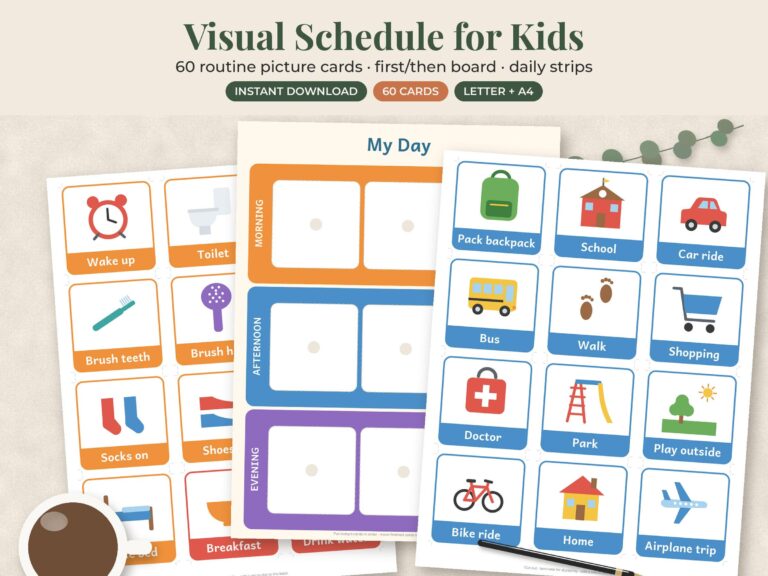
You can draw a chart by hand in ten minutes, and it will work fine. If you’d rather print one, our kids chore chart printable bundle includes morning, after-school and evening routine charts with picture steps, a blank routine chart, a 30-step reward sticker chart and an editable version. For a movable kids visual schedule, the visual schedule picture cards include 60 routine cards from morning to bedtime. You’ll find more options on our chore chart printable page.