 View details
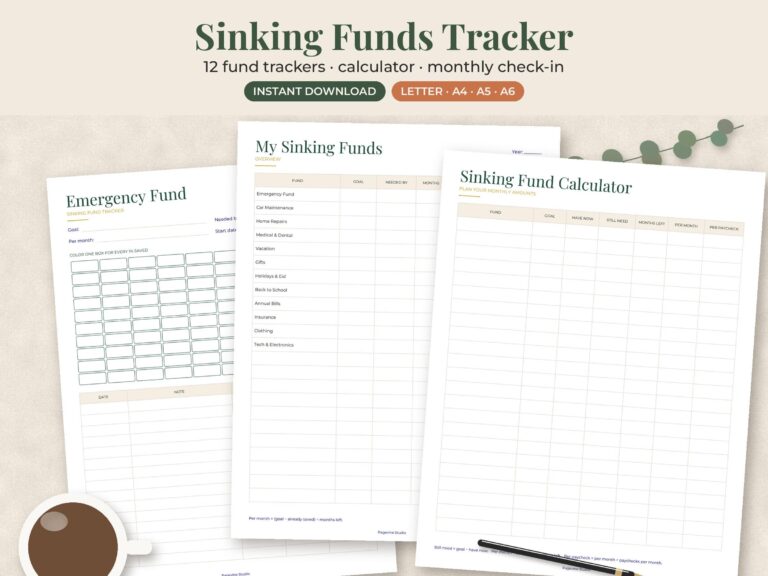
Sinking Funds Tracker and Savings Goal Printables
A sinking fund is money you save a little at a time for a cost you already know is coming, like car insurance, school supplies or a family trip. You divide the yearly cost by 12 and set that amount aside each month. A sinking funds tracker shows each goal, how much you have saved and how much is left, so a big bill becomes a small monthly line.
The printable trackers below sit in a budget binder or work on a tablet, and the savings challenges turn each deposit into a box you can color in.
How do sinking funds work?
Most budgets break in the same few months: when the car insurance renews, when school starts, when you host a big family dinner. None of these are surprises. They just do not arrive every month, so they are easy to forget when you plan.
A sinking fund fixes that with simple math. Take the yearly cost, divide by 12, and save that amount every month. When the bill arrives, the money is waiting. If the cost is due sooner than 12 months, divide by the number of months left instead.
- Yearly cost: $720 car insurance ÷ 12 = $60 a month.
- Short deadline: a $900 trip in 9 months ÷ 9 = $100 a month.
- Already started: ($900 goal − $300 saved) ÷ 6 months left = $100 a month.
A worked example: one family’s sinking funds
Here is a realistic set of annual costs for a family of four. The numbers are examples. Swap in your own from last year’s bank statements.
| Sinking fund | Yearly cost | Save each month |
|---|---|---|
| Car insurance | $720 | $60 |
| Car repairs and tires | $600 | $50 |
| Birthday gifts | $300 | $25 |
| Back-to-school costs | $240 | $20 |
| Thanksgiving hosting | $180 | $15 |
| Car registration | $96 | $8 |
| Total | $2,136 | $178 |
Without sinking funds, this family would face $2,136 in “surprise” bills spread across the year. With them, it is one $178 line in the monthly budget. That is the whole idea.
What are common sinking fund categories?
Start with the costs that caught you off guard last year. These come up for most households:
- Car: insurance, registration, repairs, tires, oil changes. A car maintenance log shows what you really spend.
- Home: repairs, appliance replacement, property tax if it is not in your mortgage.
- Kids: school supplies, clothes as they grow, sports fees, field trips.
- Health: dental visits, glasses, insurance deductibles.
- Celebrations: birthdays, Thanksgiving, weddings you are invited to.
- Annual fees: memberships, software renewals, warehouse club fees.
- Big goals: vacations, a new laptop, furniture, a car down payment.
We list more ideas with sample amounts in our post on sinking funds categories and examples.
How is a sinking fund different from an emergency fund?
A sinking fund is for costs you can see coming. An emergency fund is for costs you cannot. The Consumer Financial Protection Bureau’s guide to building an emergency fund describes it as cash set aside for unplanned expenses, such as car repairs, home repairs, medical bills or a loss of income. The CFPB also suggests setting your own rules for what counts as an emergency.
Keeping the two apart protects your emergency fund. If your car insurance is paid from a sinking fund, your emergency savings are still there when the water heater breaks. Most people track the emergency fund as one more line on the same tracker, with its own goal.
How many sinking funds should I have?
Fewer than you think. Three to six is plenty when you start. Too many small funds become hard to track, and you may feel you are failing at all of them. Begin with your two or three largest annual bills. Add one more each time a new cost surprises you.
Do I need a separate bank account for each fund?
No. Most people keep all sinking funds in one savings account and track the split on paper or in a spreadsheet. The tracker is what tells you that $1,200 in savings is really $400 car fund, $300 gifts and $500 trip. Some banks let you create named savings “buckets” inside one account, which works the same way.
The CFPB notes that saving automatically is one of the easiest ways to stay consistent. Set a monthly transfer for your total, such as $178, on the day after payday, then record the split on your tracker.
How do I use a printable sinking funds tracker?
The Sinking Funds Savings Tracker includes a sinking funds tracker for planned expenses and a savings goal tracker, designed as budget binder inserts. It comes in A5 and US Letter sizes. Here is a simple routine:
- Write one fund per section: name, goal amount and due date.
- Work out the monthly amount with the yearly cost ÷ 12 method above.
- Each payday, record the deposit and the new balance.
- When you spend from a fund, write it down and reset the goal for next year.
Printing tips: print the Letter file on 8.5 × 11 in paper at “Actual size” (100%). For an A5 binder, print the A5 file at actual size, or print two A5 pages on one A4 or Letter sheet and trim. In the UK, choose “Fit to page” if your printer only takes A4. Thicker 100–120 gsm paper (about 27–32 lb) holds up better to a hole punch.
What about savings challenges and emergency fund trackers?
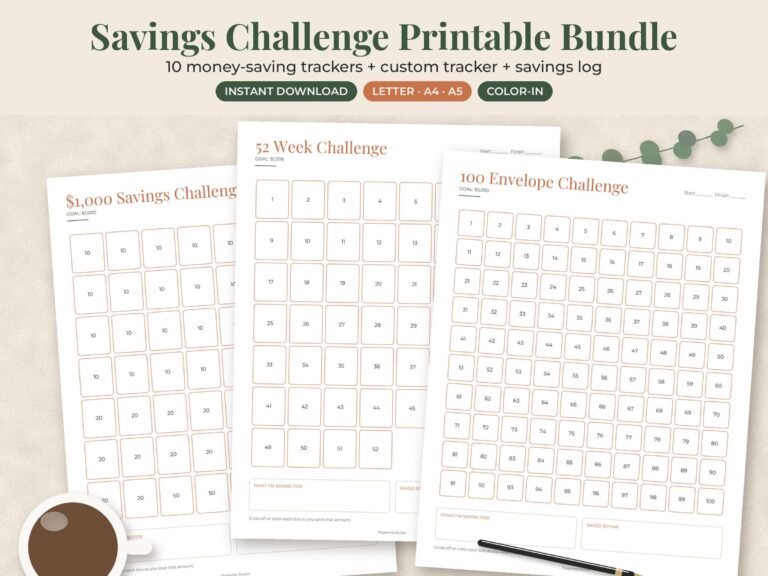
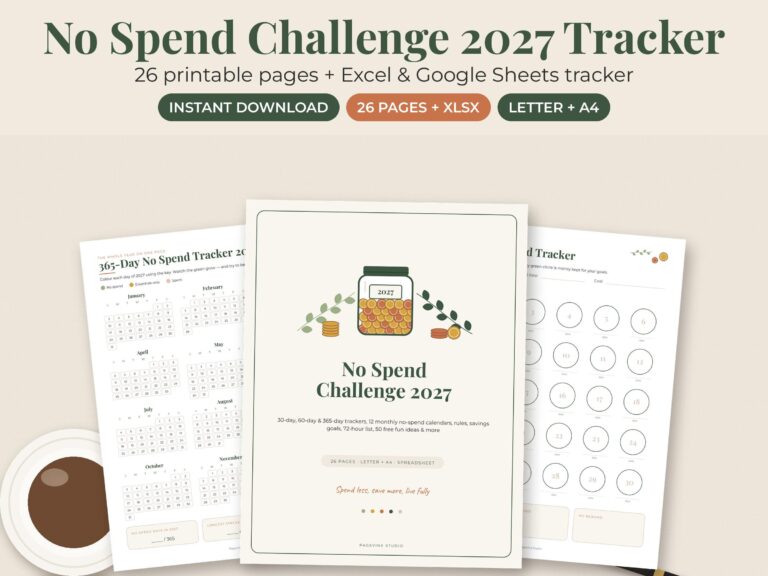
A money saving challenge is a sinking fund with a game attached. You color in a box each time you save, so progress is easy to see. The savings challenge tracker bundle has 10 money saving trackers, including a cash envelope tracker and an emergency fund tracker. For a short burst of savings, a no-spend challenge tracker helps you find extra cash to add to a fund. Read our no-spend challenge rules before you begin.
Where do sinking funds fit in my budget?
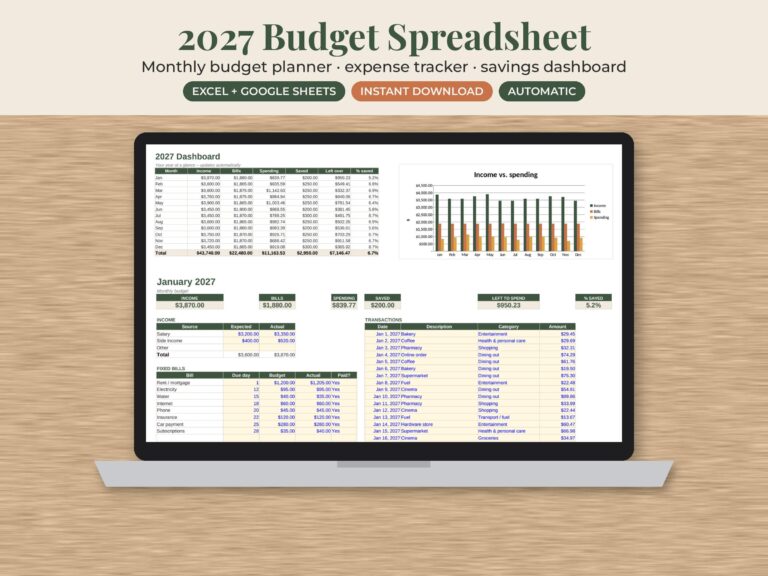
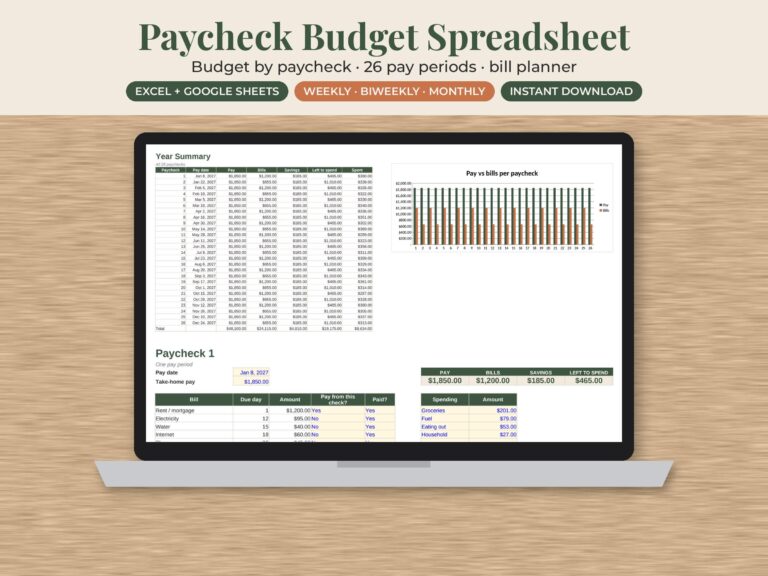
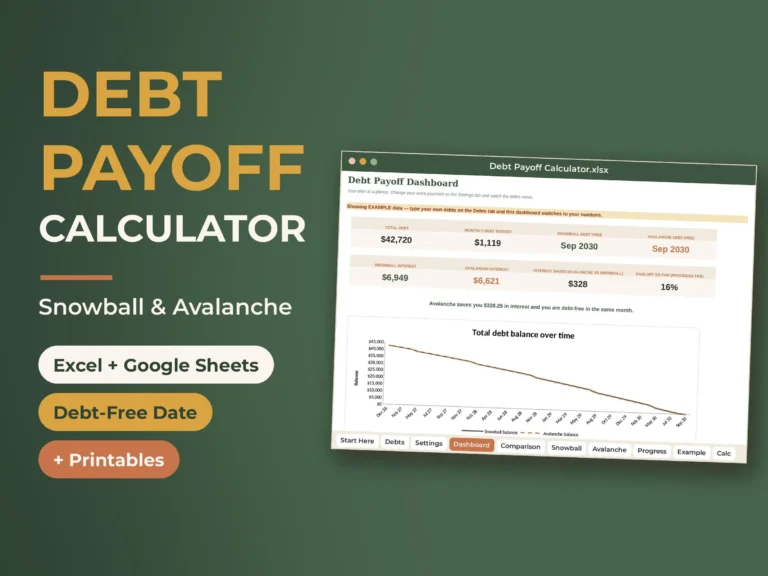
Treat your sinking fund total as a bill. In the example above, $178 sits next to rent and utilities in the monthly budget. Our budget spreadsheet guide shows how to set that up in Excel or Google Sheets, and the 2027 monthly budget spreadsheet includes its own savings tracker. Paying off debt at the same time? Sinking funds stop new bills landing on a credit card, so see the debt payoff tracker page too. The same method works in pounds or Canadian dollars.
General information, not financial advice.
Pick your two biggest annual bills, divide each by 12, and start this month. Every tracker here is an instant download from our Etsy shop, and you can browse all budget templates and spreadsheets for more.